Regulations for the Championship
1 General provisions
1.1. These Regulations govern the organisation, participation, selection, judging and determination of results of the RoboZerde 2026 national championship (hereinafter, the Championship). The rules for its four categories form integral appendices to these Regulations.
1.2. The Championship is held for students of schools, lyceums, gymnasiums, colleges and educational clubs. Teams may include students from different organisations, provided that the age limits and requirements of the selected category are met.
1.3. The purpose of the Championship is to develop engineering and digital competencies through practical drone operation, autonomous navigation, the creation of AI devices and robotics competitions. Participants independently prepare their equipment and programs, explain their decisions and follow the rules of safe teamwork.
1.4. The Championship programme includes four categories: Drone Football Pro League; AI Drones; AI Hardware Hackathon; Matrix Robotics — League of Mecha-Clash 2027, Junior–Senior division.
1.5. The in-person final will take place on 5–6 December 2026 in Astana at L. N. Gumilyov Eurasian National University. The building, entrance address and access map will be published no later than 20 November. All deadlines in these Regulations are stated in Astana time, UTC+5.
2 Organisers and management
2.1. The equal co-organisers of the Championship are:
• L. N. Gumilyov Eurasian National University;
• Daryn Republican Scientific and Practical Centre;
• Astana Daryny Centre for the Identification and Support of Gifted Children and Talented Youth;
• Yrys Group Limited LLP.
2.2. Each co-organiser is represented on the organising committee.
2.3. The technical operator for AI Hardware Hackathon is Artisan Education LLP; for Matrix Robotics, “Gruppa Robotek” LLP. Each operator prepares the venue and tasks for its category, organises technical eligibility checks, proposes judges and ensures that records are kept. Being a category operator does not replace the status of a Championship co-organiser.
2.4. The organising committee approves the schedule, panels of judges, registration channels, eligibility lists and final result records. Decisions to change the general conditions are recorded in minutes, with all co-organisers and teams notified.
2.5. The chief judge of each category is responsible for applying its rules. An appeals committee of three impartial persons considers appeals. The author of the disputed decision and representatives of interested teams do not vote; a replacement is appointed in the event of a conflict of interest.
3 Categories, participants and team composition
| Category | Age, grade or birth years | Team composition | Selection and competition format |
|---|
| Drone Football Pro League | 8–18 years inclusive | 3–5 pilots and one adult team leader; 3 pilots on the field | Up to 16 teams; admission by application and technical inspection; double elimination |
|---|
| AI Drones | 8–18 years inclusive | 2–3 participants and one adult team leader | Up to 20 teams selected remotely; three attempts in the final |
|---|
| AI Hardware Hackathon | Grades 7–9 | Exactly 3 participants and one mentor | Up to 20 teams, one per region through online selection; a project and a secret task |
|---|
| Matrix Robotics Junior–Senior | Born in 2009–2015 inclusive | 2–3 participants and one mentor aged 18 or over | Up to 20 teams; qualification and alliance playoffs |
|---|
3.1. Age in the drone categories is determined as of 5 December 2026. Matrix uses the year of birth specifically, without converting it into a general age range. The mentor is not counted among the competing participants.
3.2. A student may compete in only one team and one Championship category, including as a reserve pilot. An educational organisation may enter several teams whose memberships do not overlap.
3.3. The main competition is open to teams from the Republic of Kazakhstan. Invited teams from other countries may participate in a separate non-competitive division if this is announced before registration; they do not take national selection places or affect the official standings.
3.4. Participation in all stages is free of charge. Purchasing equipment from the organisers or their partners is not a condition of admission. Compatibility requirements for Matrix equipment and the kits for the AI Hardware secret task are specified in the relevant appendices.
4 Registration and admission
4.1. Registration and applications in all four categories are submitted at robozerde.yrys.group from 5 to 26 November 2026 inclusive, until 23:59 on 26 November, Astana time. Remote selection materials and technical information in all four categories are accepted until 26 November 2026 inclusive, 23:59 Astana time. Remote selection materials are submitted through robozerde.yrys.group, except for the AI Hardware Hackathon category: the video link and presentation are emailed to info@artisan.education. The Championship's common website is robozerde.yrys.group; it publishes the Regulations, category rules, schedule, results and registration links for all categories. The AI Hardware Hackathon category website is robozerde.artisan.education; team creation and the Documents section are available there. The learn.artisan.education platform is used for training.
4.2. The application contains the team name, category, organisation, city and region, participants' full names and dates of birth, the team leader's contact details, equipment information and the necessary consents. Matrix team names must comply with Appendix 4.
4.3. Creating an account, drafting an application or submitting materials without confirmation of receipt does not constitute admission. The secretariat communicates the status: “submitted”, “requires correction”, “confirmed”, “reserve”, “rejected” or “admitted”, and specifies the reason for rejection or the deadline for corrections.
4.4. Accreditation checks identity and age, team composition, consent from the legal representative of each minor and completion of the safety briefing. Documents for verification are presented to the organiser and are not made publicly available.
4.5. Substitutions after selection are permitted only upon a reasoned request submitted by 30 November, without changing the age group or checking authorship. AI Hardware requires approval from Artisan Education. No new participants are added after the competition begins; Drone Football Pro League permits substitutions from the approved reserve between sets.
5 Preparation and competition calendar
5.1. Applications in all four categories are accepted from 5 to 26 November 2026 inclusive, until 23:59 on 26 November, Astana time. Preparation, selection and the in-person final follow the schedule below.
| Stage | Drone Football Pro League and Matrix | AI Drones | AI Hardware |
|---|
| Applications | 5–26 November, until 23:59 | 5–26 November, until 23:59 | 5–26 November, until 23:59 |
|---|
| Preparation and submission of materials | Technical information by 26 November, 23:59 | Video, code and description by 26 November, 23:59 | Training and development: 1–26 November; video and presentation by 26 November, 23:59 |
|---|
| Review and preliminary results | Review: 27–28 November; preliminary list: 28 November | Review: 27–28 November; preliminary list: 28 November | Assessment: 27–28 November; preliminary list: 28 November |
|---|
| Approval of finalists | By 30 November, after appeals | By 30 November, after appeals | By 30 November, after appeals |
|---|
| Preparation for the final | Team rosters finalised by 30 November | Participation confirmed by 1 December; reserves by 2 December | PiBody Lite: 30 November — 1 December, after approval of finalists; preparation: 30 November — 4 December |
|---|
| In-person final | 5–6 December | 5–6 December | 5–6 December |
|---|
5.2. The detailed schedule is published by 30 November. Accreditation, a briefing and technical inspection take place before competition in all categories. Admission based on video does not replace the in-person equipment inspection.
5.3. The final provides 16 team places for Drone Football Pro League and 20 each for AI Drones, AI Hardware Hackathon and Matrix Robotics. If eligible Drone Football Pro League or Matrix applications exceed the limit, places are allocated in order of receipt of the complete set of mandatory information; the remaining teams form an ordered reserve list. The secretariat records completeness. No remote sporting ranking is introduced for these two categories.
5.4. AI Drones uses the points-based selection in Appendix 2; registration time gives no advantage. AI Hardware uses the regional selection in Appendix 3. Selection results are not carried over into the final scores of the in-person final.
5.5. Each team receives the same announced access to practice in its category. External interference, venue failure and organiser error are remedied without penalising the team; a team's own equipment failure does not, in itself, entitle it to an additional attempt.
6 Judging, appeals and approval of results
6.1. A separate record is kept for each category: team rosters, technical admission, results, penalties, publication times and decisions on appeals. No overall ranking is calculated by adding the non-comparable scores of the four categories.
6.2. An appeal against remote selection or rejection of an application must be submitted within 24 hours after notification of the preliminary decision. It is considered before the finalists are approved; the team is provided with its scores and the grounds for the decision.
6.3. At the venue, the captain or team leader submits a written protest within 10 minutes after a Drone Football Pro League or Matrix match result is communicated, and within 15 minutes after an AI Drones attempt result or AI Hardware assessment. For refusal of technical admission, the deadline is 15 minutes after notification. The secretariat records the time of receipt; no fee is charged.
6.4. The appeal identifies the team, disputed decision, relevant rule, incident, requested correction and evidence. Errors in scoring, admission, application of rules and procedure are considered. The committee does not replace the jury's assessment merely because the team prefers another one, but checks compliance with the published scale.
6.5. A dependent match, closure of selection and the awarding of affected places must not proceed until a timely appeal is decided. The decision is recorded with its reasons and communicated to the interested teams. The final result record is approved after all such appeals have been resolved.
7 Safety, independent work and responsibility
7.1. The organisers ensure that venues are enclosed and in good working order, that the power supply is safe, and that first aid and an emergency response procedure are available. The team leader accompanies minors and oversees discipline. These responsibilities do not replace one another.
7.2. Flights are permitted only in designated net-enclosed areas and on the judge's command. No people may be inside the area while propellers are running. Access to aircraft is permitted after all motors have stopped. Any participant may immediately report a hazard.
7.3. Charging is carried out at designated locations using serviceable, compatible chargers under the supervision of a responsible adult. Swollen, damaged and overheated batteries are prohibited. Soldering repairs are carried out only in an equipped area.
7.4. Teams develop their programs and engineering solutions independently. Permitted libraries and borrowed material must be disclosed. A mentor may teach before the competition and perform permitted organisational actions; concealed assistance during a scored task is prohibited. Matrix retains the permitted mutual assistance between teams for repairs outside matches.
7.5. Violations are recorded with the facts, rule and sanction specified. A correctable technical deficiency before the start is first given an opportunity for correction. Fraud, participant substitution, concealed control, collusion and dangerous actions may result in cancellation of the affected result or disqualification after the circumstances are considered. The team has the right to present its position.
8 Funding, data and awards
8.1. Travel, accommodation, meals, personal equipment and repairs are paid for by the sending organisations or teams unless a separate agreement provides otherwise. The venue and shared competition equipment are supplied by the organisers and category operators according to the allocation of responsibilities.
8.2. In each category contested, I, II and III places are awarded diplomas and medals. In Matrix, both teams of each prize-winning alliance receive awards. Valuable prizes and special award categories are announced separately; these Regulations establish no cash prize fund. Where there are insufficient teams, the category's special rules apply; non-existent places are not awarded.
8.3. Acceptance of the rules and the necessary consents of legal representatives are obtained upon application. Data use is limited to admission, communication and organisation of the Championship. Consent to optional advertising is obtained separately. Public results do not include participants' documents, dates of birth, personal phone numbers or addresses.
8.4. For learning platforms, filming, publication of competition materials and data processing, the operator announces the conditions and recipients in advance. AI Hardware videos may be hosted on any service accessible by link without requesting permission; a student's personal account is not required. Materials may be uploaded by the mentor or educational organisation with the necessary consents.
9 Document hierarchy and entry into force
9.1. The Regulations govern general organisation. Technical, game and assessment matters are governed by the appendices: 1 — Drone Football Pro League; 2 — AI Drones; 3 — AI Hardware Hackathon; 4 — Matrix Robotics with the full Russian text of the general and season rules.
9.2. In Appendix 4, the RoboZerde conditions on division, deadlines, admission, appeals, awards and the status of qualification places for external events take precedence for this event. The Matrix season rules take precedence over its general rules. A new edition of external rules does not apply automatically.
9.3. A single set of documents is published after approval by the co-organisers. No substantial changes to sporting conditions are introduced after registration closes; urgent safety measures are permitted with uniform notification and without arbitrary recalculation of results previously obtained legitimately. A change of date or venue is communicated immediately, where possible at least 10 days in advance.
9.4. The official contact details of the secretariat and category representatives are published on the website together with the application form before it begins to be used. The organisers appoint contacts for admission, appeals and emergency communication at the venue.
Appendix 1 to the RoboZerde 2026 Regulations
AI Drones Category Rules
1 Task and participants
1.1. The team develops a program that autonomously guides a drone through a course, recognises a visual code, selects the corresponding gate and lands. The team consists of 2–3 students aged 8–18 and one adult team leader; no more than 20 teams are selected for the final.
1.2. The category involves autonomous control and computer vision. Use of a neural network is not mandatory: recognition of standard markers using classical algorithms is permitted. Flight based solely on a timer or an unchanging command sequence without image processing does not meet the category's mandatory condition.
1.3. Programmable drones from different manufacturers, both commercially produced and self-assembled, are permitted. The team brings its own drone, laptop, communication equipment, batteries and spare parts. No purchase from the operator is mandatory.
2 Unified technical class
| Parameter | Requirement |
|---|
| Type | Electric multirotor with program control and an onboard camera |
|---|
| Flight mass | No more than 250 g including all protection, camera and battery |
|---|
| Dimensions | No more than 350×350×200 mm, including propellers and protection |
|---|
| Propellers | Non-metallic, no more than 100 mm in diameter; each fitted with serviceable protection against lateral contact |
|---|
| Altitude and speed | The program limits altitude to 2,2 m and translational speed to 1,5 m/s |
|---|
| Power supply | Standard or specified by the manufacturer for the installed propulsion system; damaged batteries are prohibited |
|---|
| Camera | Front-facing, downward-facing or both; the algorithm must receive images during the attempt |
|---|
| Computing | Onboard or on one team laptop; the computing arrangement does not create separate standings |
|---|
| Communication | One agreed channel between the drone and laptop; program launch and a safe emergency command |
|---|
| Reserve | One pre-inspected spare drone of the same technical class; both declared before admission closes |
|---|
2.1. IMUs, barometers, optical flow and onboard rangefinders are permitted. External cameras, motion-capture systems, ground-based positioning beacons and concealed transmitters are not permitted. The organiser does not provide shared positioning infrastructure.
2.2. After the start, video processing, navigation and route selection are performed by the program. Manual piloting, human switching of the branch, entering coordinates during flight and mentor assistance are prohibited. The only permitted intervention is an emergency stop or landing, which ends the attempt.
2.3. Scored flights are performed without accessing the internet or cloud APIs. Libraries, models and dependencies are installed in advance. Internet access for organisational communication is used outside scored runs; a local connection to the drone is permitted.
3 Remote selection and submission package
3.1. Applications are submitted through robozerde.yrys.group from 5 to 26 November 2026 inclusive, until 23:59 on 26 November, Astana time (UTC+5). The complete submission package is accepted through the same website from 1 to 26 November inclusive, until 23:59 on 26 November, Astana time. Selection determines readiness to participate safely and independent development. Remote flight speeds are not compared, as teams have different venues and models.
3.2. The team provides four items: an uncut video, a code archive, a technical data sheet and a brief description of the solution. Links must remain accessible to the judges until appeals are completed. Public posting and social media promotion are not required.
3.3. The video, up to eight minutes long, is filmed as a single continuous wide shot, with no editing, speed-up or frame substitution. It must show the team, drone, working screen or a parallel screen recording, the start and the entire mini-course. At the beginning, participants name their team and show the verification code issued by the secretariat after registration.
3.4. The video shows two autonomous runs of the same program version: one with marker ID 0 and one with marker ID 1. Only the physical marker is changed between them; editing the program and human switching of branch selection are prohibited. Restarting the program, returning the drone to the start and changing the battery are permitted.
3.5. In each run, the drone takes off, reads the marker, selects the left or right opening under the rule in clause 6.2, passes through it and lands in the finish zone. The recognised ID and selected branch are visible on the screen or in the log. The same SHA-256 checksum of the program archive is shown before and after the flights.
3.6. Selection uses a safe enclosed venue or a closed area without people, two identical openings of at least 800×800 mm with centres at a height of 1 m, and start and landing zones 1 m in diameter. The openings are placed to the left and right of the starting direction at equal distances of at least 1,5 m from the start. Participants demonstrate dimensions using a tape measure. The minimum clear area is 3×3 m, with a height of 2,3 m; a larger area is permitted.
3.7. If both branches and the landing cannot fit safely within the chosen area, a larger venue and its layout must be used; safety distances must not be reduced for the video. The performance may be recorded at an available partner venue, provided that only the registered students operate for the team.
Translation of the image
AI Drones. Mini-course for remote qualification
Two autonomous launches of the same program version
The branch is selected from the camera image, not manually
Left opening: ≥ 800 × 800 mm. Right opening: ≥ 800 × 800 mm.
Forward from the start
Launch 1 · ID 0. Launch 2 · ID 1.
S — Start · zone Ø 1 m
Centre height: 1 m. Distances from the start are equal and ≥ 1.5 m.
In each launch
Take-off → read ID → selected opening → landing in the Ø 1 m zone
Only the physical marker is changed. The program version remains the same.
Layout of the remote selection mini-course. The in-person final field may differ from the remote selection field; this diagram is not the final field layout. Schematic illustration, not to scale: exact coordinates of the marker and finish zone are not specified. They are positioned safely under clauses 3.6–3.7. The minimum clear area is 3×3 m, with a height of 2,3 m; a larger venue is used if necessary. The labels ID 0 and ID 1 are not printable markers; ArUco DICT_4X4_50 is used.
3.8. The archive contains source code, a README with launch instructions, a list of dependencies and licences, files for the team's own models or identification of an open source, the drone configuration and logs of the two flights. Passwords, private keys and other secrets must not be included. Restricted access for judges is permitted.
3.9. The technical data sheet (no more than two pages) must contain:
The drone model, mass and dimensions.
Power supply and protection information.
Information on the camera and computing method: onboard or on the team's laptop.
The emergency command and the drone's behaviour upon loss of communication.
The solution description (no more than three pages) must explain:
Navigation: how the program autonomously guides the drone along the mini-course.
Marker reading: how the camera image is used to recognise the ID and select the corresponding branch.
The program's actions upon loss of the image.
Each participant's contribution: which part of the solution each team member completed.
3.10. If an archive is damaged or a link is technically inaccessible, the secretariat allows 24 hours to restore access to the same materials. The project or flight result must not be replaced after the deadline.
4 Selection assessment and formation of the final
| Component | Measurable indicators | Maximum |
|---|
| Flight demonstration | In each of the two runs: autonomous take-off 3; correct ID reading 5; correct branch and passage 8; controlled landing within the zone 4 | 40 |
|---|
| Algorithm and reproducibility | Image processing 10; connection between the decision and flight commands 10; rerun following the README and handling of abnormal states 10 | 30 |
|---|
| Independent work | Participants' explanation of the code 10; verified allocation of work 5; completion of a short verification check 5 | 20 |
|---|
| Technical readiness | Compliance with the class and protection 5; a working emergency command and safe response to loss of communication 5 | 10 |
|---|
| Total | Remote selection scores are not carried over to the final | 100 |
|---|
4.1. For a ten-point criterion: 0 — absent; 5 — partially implemented or not fully verified; 10 — works and is reproducible. For a five-point criterion: 0, 2 or 5 for the same levels. Demonstration points are awarded only for the actual visible result of each run.
4.2. Mandatory admission conditions: at least 60 points; at least one fully autonomous, safe run with the correct branch selected using the camera; technical compliance with the class; confirmation of authorship. Scores in other components do not compensate for failure to meet these conditions.
4.3. Judges conduct a video check lasting up to 10 minutes for all candidates for the 20 places and the nearest reserves. Participants explain a selected code fragment and, without mentor assistance, demonstrate reading a marker presented by the judge or safely changing a program parameter. The check follows the same structure for all teams and does not become another speed contest.
4.4. A single ranking without regional quotas is formed from total scores. Ties are resolved by comparing, in order, flight demonstration, algorithm and independent work scores. If a tie remains at the twentieth-place cutoff, an identical additional recognition verification task is conducted with equal time; its conditions are sent to all tied teams simultaneously.
4.5. The 20 highest-ranked teams meeting the mandatory conditions advance to the final. If there are fewer, all qualifying teams are invited; the threshold is not lowered retrospectively. The remaining eligible teams form a ranked reserve list. The selection record contains component scores and grounds for non-admission.
4.6. Materials are reviewed on 27–28 November. The preliminary list is published on 28 November, and appeals are accepted within 24 hours after publication; the final list is approved by 30 November after appeals have been considered. Participation must be confirmed by 1 December. A team that withdraws is replaced in order by the next reserve team by 2 December.
4.7. Further development of the same solution and correction of errors are permitted before the final. The team submits its final version and details of changes at in-person admission. A different drone model or computing arrangement must be agreed in advance with the technical committee without changing the technical class.
5 Final course
5.1. The in-person final field may differ from the remote selection field. The selection diagram is not the final field layout. The flight zone is 8×4 m, with netting 3 m high and closed sides and top. No people are inside during a run. The floor is matte, without mirrored surfaces; lighting is uniform. The organiser provides identical practice conditions and allocates local radio channels.
5.2. The course contains start S, first gate G1, recognition zone M, two alternative branches G2A and G2B, common gate G3 and landing pad L. Only one G2 branch is traversed. Each passage is directed from start to finish.
| Element | Base centre on the plan, in metres | Height of the opening centre |
|---|
| S | x=0,7; y=2,0 | Start on the floor |
|---|
| G1 | x=2,0; y=2,0 | 1,0 m |
|---|
| M | x=3,5; y=2,0 | A vertical marker at a height of 1,0 m and its duplicate on the floor in front of the panel |
|---|
| G2A | x=5,0; y=3,0 | 1,0 m |
|---|
| G2B | x=5,0; y=1,0 | 1,0 m |
|---|
| G3 | x=6,5; y=2,0 | 1,5 m |
|---|
| L | x=7,3; y=2,0 | Landing on the floor |
|---|
5.3. Coordinates are measured from the lower-left corner of the diagram, with the x-axis directed from start to finish. Gate openings are 800×800 mm, soft or protected by soft material; frame thickness is no greater than 100 mm. Zones S and L are circles 1 m in diameter. Supports are positioned outside the usable opening.
5.4. Large labels G1, A, B and G3 are placed on the gates. The operator publishes the basic dimensions, contrasting appearance of the frames, photographs, marker files and a recognition test example by 1 November. These materials are available to all registered teams.
5.5. Before each round, the centres of G1 and G3 may be shifted along y by no more than 0,25 m and their heights changed by no more than 0,15 m, identically for all teams. The remaining geometry is retained. The judge announces the layout before a shared 15-minute program-adjustment window; changes are not applied during a round.
5.6. Gate dimensions, marker format, ID-to-branch mapping and course-change limits do not change after registration. Fixed supports and panel M are protected; teams are shown the routes around the panel. The drone is not required to cross the physical panel M.
Translation of the image
Top view — 8 × 4 m
S; G1; M; G2A; G2B; G3; L; x; y. ID 0 → A. ID 1 → B.
Direction from start to finish →. Net height: 3 m.
Basic course layout. Dashed lines show both permitted branches; one is traversed per attempt.
6 Computer vision and autonomy
6.1. M uses ArUco, dictionary DICT_4X4_50, ID 0 or ID 1. The outer side length of the black square is 200 mm; the white border is at least 20 mm on each side; printing is matte, without scaling or distortion of proportions. The vertical marker and its floor duplicate have the same ID within an attempt.
6.2. ID 0 means branch A — left when facing from the start; ID 1 means branch B — right. Both alternatives have equal status, and the openings are positioned symmetrically. Each drone reads the ID using its own camera during the attempt. Processing a previously saved image instead of the current video is prohibited.
6.3. The judge sets the ID after the program is locked and before the start. Both IDs are used across each team's three attempts: one appears twice and the other once; the sequence is determined by a concealed draw. An additional attempt in the event of a complete tie uses the same ID for the tied teams. The team must not enter the displayed ID value into the program before the start.
6.4. The program is locked before each round using a SHA-256 checksum. After locking and until the attempt is performed, editing and command input are prohibited except for the single launch and emergency termination. Between rounds, students may refine their code during the allotted time; the mentor must not program for the team.
6.5. One program launch is permitted on the judge's signal. Thereafter, flight commands come only from the algorithm. Screen recording and an event log with timestamps, the recognised ID and selected branch are enabled on the laptop. Judges may check the code, model files and the log's consistency with the video recording.
6.6. Before scored runs, the judge conducts a short test: after the program is locked, the judge changes the displayed marker, and the students demonstrate a change in the recognised ID without manual selection. The branch shown in the test does not remove the requirement for recognition in every scored attempt.
7 In-person inspection and organisation of rounds
7.1. The technical committee checks mass and dimensions in flight configuration, protection, battery, radio channel, video stream, software limits and two commands — normal autonomous completion and emergency landing or stop. Loss of communication is tested safely. An aircraft without a functioning emergency response is not admitted.
7.2. After substantial repairs, replacement of the camera, firmware or propulsion system, or a switch to another model, the affected parameters are checked again. Replacing a battery with an identical serviceable one is permitted without a full committee inspection.
7.3. Each team is given five minutes on the main course before the scored rounds. The team selects its emergency-command operator in advance; this must be a registered student. The safety judge has an independent right to stop an unsafe flight.
7.4. All admitted teams make one attempt in each of three rounds. The order in the first round is determined by a draw, the second is the reverse order, and the third is determined by a new open draw. No team performs all three runs consecutively. There is no elimination from the final after the first round.
7.5. The called team is given one minute for setup and connection. Once ready and upon the signal, an attempt lasting up to 180 seconds begins. Up to two minutes are allotted for changing teams and resetting the field. Batteries are prepared in advance; relaunching from the floor after the start is prohibited.
8 Attempt execution and scoring
8.1. The sequence is mandatory: autonomous take-off → G1 → reading M → correct G2A or G2B → G3 → landing L. Each element scores only once. If an element is missed, the drone may return and complete it correctly before time expires; subsequent elements do not count until then.
| Element | Scoring condition | Points |
|---|
| Take-off | After the start, the drone independently rises and remains airborne for at least 2 seconds | 5 |
|---|
| G1 | The entire drone passes through the opening in the required direction | 15 |
|---|
| M | The current ID is correctly read by the camera and recorded in the log before the branch is selected | 15 |
|---|
| G2 | The correct branch for the current ID; the entire drone passes through the opening | 25 |
|---|
| G3 | Complete passage after the correct branch | 20 |
|---|
| L | After all elements, the drone lands with its entire projected footprint inside circle L and stops its motors | 20 |
|---|
| Maximum | Before deduction of penalties | 100 |
|---|
8.2. Flying outside the frame, bypassing a gate and partial entry do not count as passage. Reading the ID again gives no additional points. Passing through the wrong branch earns no G2 points; the drone may return and complete the correct branch, and time does not stop.
8.3. A successful landing requires the drone's entire projected footprint, including protection, to be inside the circle and its motors to remain stopped for at least three seconds. Touching the line means crossing the inner boundary and earns no L points. Landing outside the zone ends the attempt without L points.
8.4. Time is measured from the authorised program launch until first contact in a subsequently confirmed successful landing. For an unfinished course, the record states “not completed” rather than a notional record time. At 180 seconds, the judge terminates the flight with the emergency command; points already earned legitimately are retained.
8.5. One continuous contact with a gate frame or panel M incurs minus 5 points; separation followed by another touch constitutes a new contact. If the contact creates no hazard and the drone continues controlled flight, the attempt continues. The minimum final attempt score is zero.
8.6. Contact with the net incurs minus 10 and ends the attempt. A fall, unintended floor contact or use of the emergency command ends the attempt, retaining previously earned legitimate points and assessed penalties, without finish points. A person must not enter while propellers are running.
8.7. Manual course correction, concealed commands and code substitution result in a zero score for the attempt; repeated or deliberately concealed intervention is considered grounds for disqualification. Emergency termination for safety is not considered manual course completion and is not, in itself, a disciplinary violation.
8.8. If the enclosure is breached, the drone flies towards people or safe control is lost, the judge stops the attempt immediately. The cause must be remedied and admission renewed before the next start. The sanction for a dangerous action is determined according to its circumstances.
9 Final result, repeats and records
9.1. The result is the sum of the two highest-scoring attempts out of three, with a maximum of 200. Selection scores are not added. The two attempts are selected automatically by points; in a tie, preference goes to a completed attempt, then to the shorter confirmed finish time, then to the earlier attempt number.
9.2. Tied final totals are resolved by comparing, in order: the number of fully completed courses among the two selected attempts; the sum of those finish times, if their equal number is greater than zero; the best single score; and the third attempt's score. Times of unfinished flights are not used as an advantage.
9.3. If a tie remains and affects I–III places or the award cutoff, an additional attempt is held using an identical layout and the same ID. Points are compared, followed by whether there was a full finish and its time. If a complete tie occurs again, a shared place is awarded and the corresponding next place is skipped; no endless series is held.
9.4. Confirmed external interference, failure of the organiser's infrastructure, an officiating procedural error or displacement of a gate through no fault of the team results in a full repeat of the attempt. The annulled attempt is not selected for the final result. The repeat uses the same layout and ID after the field is restored.
9.5. Battery depletion, failure of the team's own program, loss of communication affecting only that team without a confirmed external cause, a collision caused by the team's own error and equipment unreadiness do not entitle the team to a repeat. In a general radio failure, the judge records the affected teams and applies the same decision to all.
9.6. A scoring judge, a safety judge and a secretary work on the course; a technical inspector handles admission. An official wide-angle flight recording showing the openings, start and landing is mandatory. If visibility is inadequate, a camera is added rather than assuming passage through an unseen element.
9.7. The attempt record contains the team, round number, marker ID, program hash, drone identifier, scoring for each element, contacts and penalties, whether and when a full finish occurred, the reason for stopping, a recording link and the judge's signature. The team reviews it before the appeal period begins.
9.8. A protest must be submitted within 15 minutes after the result is communicated, under section 6 of the Regulations. Round results are published before the next round begins; a dispute affecting starting conditions or admission is resolved before the relevant run.
10 Category provision
10.1. The organiser provides an enclosed course, soft gates, two sets of verified markers, markings, scales and measuring tools, video recording, a timer, power outside the flight zone and a holding area. The team provides approved aircraft, a laptop, the software environment, batteries and an emergency interface.
10.2. For 20 teams, one course provides 60 scored slots of approximately six minutes each and 100 minutes of total time for sequential individual practice. Technical admission and code checks are conducted at separate workstations. The two-day schedule includes breaks and reserve time for repeats; practice access must not be selectively reduced.
10.3. The operator publishes the technical package by 1 November and answers general questions through a single clarification section until 26 November. Clarifications do not change the published limits or scoring scale. All teams have access to the same current version of the package.
Appendix 3 to the RoboZerde 2026 Regulations
Matrix Robotics Rules
League of Mecha-Clash 2027
Junior–Senior, born in 2009–2015
1 RoboZerde category conditions
1.1. The technical operator is “Gruppa Robotek” LLP. The category follows the theme Undersea Core Contest — “Battle for the Ocean Core”, original version V1.0 dated 16 August 2026. The full Russian text of the general rules and the full Russian text of the season rules, with all diagrams, are reproduced below in this appendix.
1.2. RoboZerde holds the official Junior–Senior division for participants born in 2009–2015. A team consists of 2–3 students and one mentor aged 18 or over. The provisions of the season document relating to this division apply to participants.
1.3. There are 20 team places in the final. Applications are submitted through robozerde.yrys.group from 5 to 26 November 2026 inclusive, until 23:59 on 26 November, Astana time. Robot information is accepted through the same website from 1 to 26 November inclusive, until 23:59 on 26 November, Astana time. Preliminary inspection materials: a photo of the robot, team composition, a technical passport stating the mass and listing the electronics, an emergency-stop diagram and a brief description of the design. This is a technical eligibility check without a separate project ranking. If the limit is exceeded, places are allocated under clause 5.3 of the Regulations.
1.4. The team brings its own assembled robot, joystick, program, power supply and permitted spare parts. The operator provides the competition field, game objects, cards and official measuring instruments. Pre-assembled interchangeable units are not permitted in cases prohibited by the general rules.
1.5. Team name: no more than 20 characters, using only A–Z, a–z, digits, spaces and hyphens. Interschool teams are permitted. One student with a mentor does not constitute a team.
2 Summary technical parameters
| Junior–Senior parameter | Requirement of the original rules |
|---|
| Starting dimensions | No more than 32×32 cm in length and width; height is unrestricted |
|---|
| Mass | No more than 1800 g including the battery |
|---|
| Power supply | One secured battery pack with a nominal voltage no higher than 12 V |
|---|
| Controller | One MATRIX Mini V2.0 or later, or MATRIX R4 V1.0; expansions only where expressly permitted |
|---|
| Control and drive | One MATRIX MJ2 or MJ5; no more than two MATRIX TT or TT Encoder motors up to 5 V for locomotion |
|---|
| Servos | For mechanisms, not locomotion; no more than 25 kgf·cm at 5 V, with specified characteristics |
|---|
| Main structure | Chassis and load-bearing frame made of MATRIX metal parts; custom-made parts in permitted assemblies |
|---|
| Field | 188×188 cm; markings, bases, trident and game objects as shown in the season rules diagrams |
|---|
| Match | 2 minutes 30 seconds: 30 seconds autonomous and 2 minutes remote-controlled; the last 30 seconds are included in these 2 minutes |
|---|
2.1. The table does not replace the full text of the rules. In the event of a discrepancy, the original technical rule for Junior–Senior applies.
3 RoboZerde format, standings and awards
3.1. An alliance consists of two teams. Each team plays at least four qualification matches with changing partners and opponents. If more matches are played, the four best are counted according to the ranking order in the original rules. In qualification, an alliance win earns a team 3 tournament points, a draw 1 and a loss 0; game points are counted separately.
3.2. Play-off partners are selected under the original rules from the top 50 percent of the rankings. With 8–15 teams, 2 alliances are formed; with 16–20, 4. Brackets, the number of captains and the selection procedure are published before qualification. With four alliances, a play-off encounter consists of one match, and an alliance is eliminated after two losses; a grand final reset is used if the lower-bracket alliance wins. With two alliances, a final series is held immediately, with two wins required and a maximum of three matches, as in the two-alliance diagram.
3.3. At least eight eligible teams are required for official standings. With fewer teams, a demonstration event is held without official prize places; this is announced before the draw. Any other format requires an addendum published in advance.
3.4. I and II places are awarded to the winner and finalist of the final alliance encounter; III place goes to the alliance that loses the lower-bracket final. With two alliances, III place is not awarded. Each of the two teams in a prize-winning alliance receives the same placing; participants receive awards under the general Regulations.
3.5. Ties in qualification and the play-offs are resolved under section 4.2 of the general rules. In particular, once the game-based play-off tiebreaking criteria have been exhausted, the original rules give the advantage to the red alliance; the colour is determined by the drawing procedure before the match, rather than chosen by a judge after the result.
3.6. In Junior–Senior, reading an AprilTag with an onboard camera is mandatory during autonomous “Exploration”. The penalty for failing to complete the target cube and other point calculations apply as set out in the season text. The operator provides the printed tags, their placement and the agreed print file in the technical package by 1 November; colours, dimensions and placement are checked before matches.
3.7. RoboZerde awards alliance placings. Special Excellence, Strategy, Rookie and Ambassador awards, international rankings and wildcards are possible only under a separate operator document published before registration, confirming its authority and specifying criteria and the number of advancement places. Without this document, the relevant clauses of the original text do not confer entitlement to an award or progression to the next stage.
3.8. The general rules allow assistance from other teams with repairs outside a match; during a match, each robot is controlled only by members of its own team. Mentors comply with competition-area restrictions and do not perform actions on behalf of students.
4 Application of the full text
4.1. The following includes 30 pages of the Russian version: 9 pages of general rules and 21 pages of season rules with diagrams of fields, objects and brackets. The original numbering is retained; the overall page numbering continues at the bottom of the pages.
4.2. For RoboZerde, the deadlines, selected division, free participation, eligible team composition, awards, status of external advancement places and appeals procedure established by these Regulations and sections 1–3 of the appendix apply. A match protest must be submitted within 10 minutes of the result being announced.
Translation of the image
League of Mecha-Clash 2027 General Competition Rules
Junior–Senior · Age group: born in 2009–2015
Undersea Core Contest — “Battle for the Ocean Core”. Original version V1.0 dated 16.08.2026.
1. General information
1.1. About the competition
MARC LOM (League of Mecha-Clash), the “Battle for the Ocean Core” season, is an alliance competition. Teams build robots from the MATRIX Metal Kit; in Elementary, structural parts from other manufacturers are permitted in accordance with section 3. In each match, robots first act autonomously and are then remotely controlled. Two teams form an alliance: they collect energy cubes, compete for the ocean core, perform hanging and use offensive and defensive tactics.
1.2. Document hierarchy
1.2.1. The general rules establish requirements for teams and age divisions, robots, the competition format and penalties, as well as procedures for special awards and additional qualification places — wildcards.
1.2.2. Season rules are issued annually and define the theme, field and game-object configuration, markings, match procedure and task scoring.
1.2.3. Separate announcements govern organisational procedures: selection for special awards, advancement to the next stage and allocation of wildcards, and the regulations for a specific event.
1.2.4. If the general and season rules conflict, the season rules apply. Unresolved matters and the arrangements for a specific event are governed primarily by that event’s regulations.
2. Teams and divisions
2.1. Team composition
2.1.1. A team consists of 2–3 students who meet the division’s requirements. Participants from different schools and grades are permitted.
2.1.2. A team may have one mentor aged 18 or over. A mentor may work with students from different schools.
2.1.3. One student and one mentor do not constitute a team: such a group is not admitted, or its results are not counted.
2.1.4. The students themselves must develop the robot’s design and program. Judges may ask participants to explain its construction and program logic. If participants clearly cannot do so and the judges establish that the work was not done by them, the team’s results for that day are annulled.
2.1.5. The name is specified at registration. Only English letters A–Z and a–z, digits 0–9, spaces and the hyphen (-) are permitted; the total length must not exceed 20 characters including spaces. Other alphabets, punctuation and symbols are prohibited. An unsuitable name must be corrected before registration closes, otherwise the application is not accepted. Names are not shortened automatically. The organiser may require replacement of
Translation of the image
a name that is inappropriate, offensive or infringes another party’s brand or trademark rights.
2.2. Age divisions for the 2027 season
2.2.1. During the season, a team may register in only one official division — Elementary or Junior–Senior; all its participants must belong to the same division. The exception is Club: any participants may additionally enter it, including already registered teams and teams that did not qualify. Club matches do not count towards official tournament points, rankings, special awards or wildcards (see 2.3).
2.2.2. Elementary: participants born in 2016–2021 inclusive.
2.2.3. Junior–Senior: participants born in 2009–2015 inclusive.
2.2.4. The ranges do not overlap. Division is determined exclusively by year of birth. Early or late school entry, home schooling, repeating a grade and other educational circumstances do not entitle a participant to change division.
2.2.5. Club has no age divisions; its composition and rules are set out in 2.3. Clauses 2.1 and 2.2 apply to Elementary and Junior–Senior.
2.3. Club division
2.3.1. Club is intended to promote robotics and club participation. It is open to people of any age, including adults, with no age groups.
2.3.2. A team has 1–3 people; one participant may also form a team and be its representative. If all participants are minors, the representative must be an adult.
2.3.3. Hardware and structural-part requirements are the same as for Junior–Senior (section 3).
2.3.4. Remote control is permitted throughout the match (see 3.5).
2.3.5. Matches are held in a separate Club block. Their number may vary depending on the schedule. The same field, objects, scoring system and basic rules are used as in the official divisions. Certificates may be awarded based on the day’s final honorary ranking.
2.3.6. Club does not participate in official standings, rankings, special awards or wildcards; advancement to the next stage is not provided.
2.3.7. The availability of Club is announced in the regulations for the specific event. It is not held at every competition.
2.3.8. Safety requirements, starting dimensions and on-field penalties are governed by these general rules; fees and the schedule are governed by the event regulations.
3. Robot requirements and technical limits
3.1. Dimensions, mass and power supply
3.1.1. In its initial configuration before launch in the starting zone, the robot must fit within 32 × 32 cm in length and width. Height is unrestricted. After launch, expansion is not restricted by these dimensions.
Translation of the image
3.1.2. Total mass including the battery must not exceed 1200 g for Elementary and 1800 g for Junior–Senior. Measurement is performed on the official electronic scales before the match. An overweight robot is not admitted.
3.1.3. One securely attached battery pack with a labelled nominal voltage no higher than 12 V is permitted. It must power both the controller and the drive system simultaneously. Other batteries on the robot are prohibited regardless of purpose: propulsion, ballast or otherwise.
3.2. Permitted hardware system
3.2.1. One MATRIX Mini V2.0 or newer controller, or MATRIX R4 V1.0. Expansion boards are prohibited except for the MATRIX MJ2 or MJ5 receiver adapter. Connecting multiple controllers is prohibited.
3.2.2. One MATRIX MJ2 or MJ5 joystick set per team, regardless of model.
3.2.3. Only MATRIX TT or MATRIX TT Encoder motors with operating voltage up to 5 V are permitted for locomotion, no more than two. Any motor that moves the robot as a whole, including a servo modified for continuous rotation, counts as a drive motor and is included in this limit.
3.2.4. Servos may be from any manufacturer, but only for mechanisms: grippers, lifts, steering-mechanism rotation and the like. They must not be used for locomotion. Their number is limited by the controller’s available ports. Maximum torque at 5 V is 25 kgf·cm inclusive, based on the manufacturer’s stated maximum stall torque. Servos without labelled specifications or with torque above 25 kgf·cm are prohibited.
3.2.5. The number, specifications and combination of sensors, cameras and motors must comply with the controller’s port count and functional limitations.
3.3. Structural parts
Junior–Senior — the main structure must be MATRIX.
3.3.1. The chassis and main load-bearing frame must consist solely of MATRIX metal parts. Ready-made one-piece moulded chassis are prohibited.
3.3.2. For other parts — grippers, motor mounts, body panels and the like — self-made parts, including 3D-printed and laser-cut parts, are permitted alongside MATRIX metal parts.
3.3.3. All commercially purchased modular parts from other manufacturers are prohibited, including plastic building-block parts.
Elementary — structural parts are freely chosen; power and electronics must be MATRIX, except servos.
3.3.4. Commercially purchased or self-made non-MATRIX parts are permitted for the chassis, frame, body, brackets, gripper parts and other structural components: plastic construction sets, 3D printing and laser cutting. They may be combined with MATRIX metal parts. Ready-made commercial robots and one-piece moulded chassis are prohibited: the robot is assembled from parts and the students develop the design themselves (see 2.1).
3.3.5. A ready-made vehicle or one-piece moulded chassis means a product or kit from one supplier that already has a functioning drive chassis without
Translation of the image
the user assembling the structure themselves. This includes ready-made combat robots, radio-controlled vehicles and robotics platforms. The main chassis must be assembled from at least two separate detachable structural parts using standard fasteners: screws, nuts, rivets, clips and the like. A purchased ready-made drive module must not be used directly as the main structure. A one-piece part made independently by the team through 3D printing or laser cutting is considered self-made and is not covered by this prohibition.
3.3.6. The controller, joystick, sensors, cameras, drive motors, transmission components and battery pack must be MATRIX. Servos may be from any manufacturer provided that torque and quantity limits are met. The remaining limits are as in 3.1 and 3.2.
3.3.7. Commercial or self-made adapters are permitted for connecting other manufacturers’ parts to MATRIX motors and transmission. They serve only as mechanical connections and must not circumvent electrical limits: no more than two MATRIX TT/TT Encoder motors, the servo limits, and one battery up to 12 V.
3.3.8. All non-MATRIX power and electronic components are prohibited, including motors, controllers, sensors and battery packs of other brands, LEGO motors and Power Functions or Powered Up motors/hubs. Power and electronics must be MATRIX. Permission to use other brands of servos is separately established in 3.3.6.
3.4. Safety — both divisions
3.4.1. Water, fire, gas and dangerous striking or sharp devices, such as hammers and blades, are prohibited. Structural parts must not be used as dangerous weapons or in a manner that threatens safety.
3.4.2. A team is allowed one robot; a spare robot must not be brought onto the field. Spare parts are presented disassembled: as individual parts or minimal assemblies that cannot be placed on the field in their entirety as a replacement module. Preassembled replacement assemblies are prohibited, for example a complete gripper, assembled transmission or chassis module with motors.
3.4.3. If a poorly secured battery or battery pack detaches and falls onto the field, the robot is forcibly stopped and removed from the field for safety reasons.
3.5. Launch and control
3.5.1. During the autonomous Exploration phase in Elementary and Junior–Senior, the joystick lies on the floor in the team’s alliance zone. On the start signal, all teams simultaneously press the triangle △ button once. From launch until the Scramble phase signal, touching the joystick is prohibited except to press the emergency stop.
3.5.2. The robot must stop before Exploration ends: either automatically under program control within 30 seconds of the single launch, or using the assigned emergency-stop button, pressed without lifting the joystick from the floor.
3.5.3. During Scramble, remote control is permitted only after the signal. Premature control or continued robot movement during the transition between phases incurs a points deduction under the season rules.
Translation of the image
3.5.4. In Club, remote control is permitted throughout the match, including during Exploration. A single autonomous launch is not required and there is no penalty for early remote control. However, Exploration scoring and the prohibitions on touching the white centre line, ruins columns, the opponent’s half and the ocean core remain in force.
4. Competition format and ranking
4.1. Alliances — Elementary and Junior–Senior
4.1.1. The format in this section applies to the two official divisions. Club is not included in alliance qualification matches, playoffs, tournament points or rankings; it has a separate block (2.3).
4.1.2. The competition includes qualification and alliance playoffs. An alliance consists of two teams.
4.1.3. On competition day, after participant check-in, the organiser randomly assigns partners and opponents for each match and publishes the schedule.
4.1.4. If a team is absent, the lineup is reassigned or the place is filled. If there are still too few teams, a team is selected by draw for an additional match. This is solely to fill an opponent vacancy; its result, game points and tournament points do not count for the selected team in qualification, the alliance points total or the best-four-match standings.
4.1.5. Each team plays at least four qualification matches. If there are more, the four best count. A win on game points gives each team in the winning alliance 3 tournament points; a draw gives 1, and a loss 0.
4.1.6. Alliance captains are determined by qualification ranking. Only teams in the top 50% may participate in partner selection. A captain invites a lower-ranked team. A team that declines is removed from the selection list, except where it is itself a captain or becomes one in turn. The number of captains depends on the total number of teams (Table 1).
4.1.7. The organiser may adjust the number of selected alliances/captains according to the actual participant count, based on Table 1.
Table 1. Relationship between participant and alliance numbers.
Table columns: Total teams; Teams in alliance selection; Alliances / captains; Teams in playoffs.
Total teams: 8–15; Teams in alliance selection: 4–8; Alliances / captains: 2; Teams in playoffs: 4.
Total teams: 16–23; Teams in alliance selection: 8–12; Alliances / captains: 4; Teams in playoffs: 8.
Total teams: 24–31; Teams in alliance selection: 12–16; Alliances / captains: 6; Teams in playoffs: 12.
Total teams: 32–40; Teams in alliance selection: 16–20; Alliances / captains: 8; Teams in playoffs: 16.
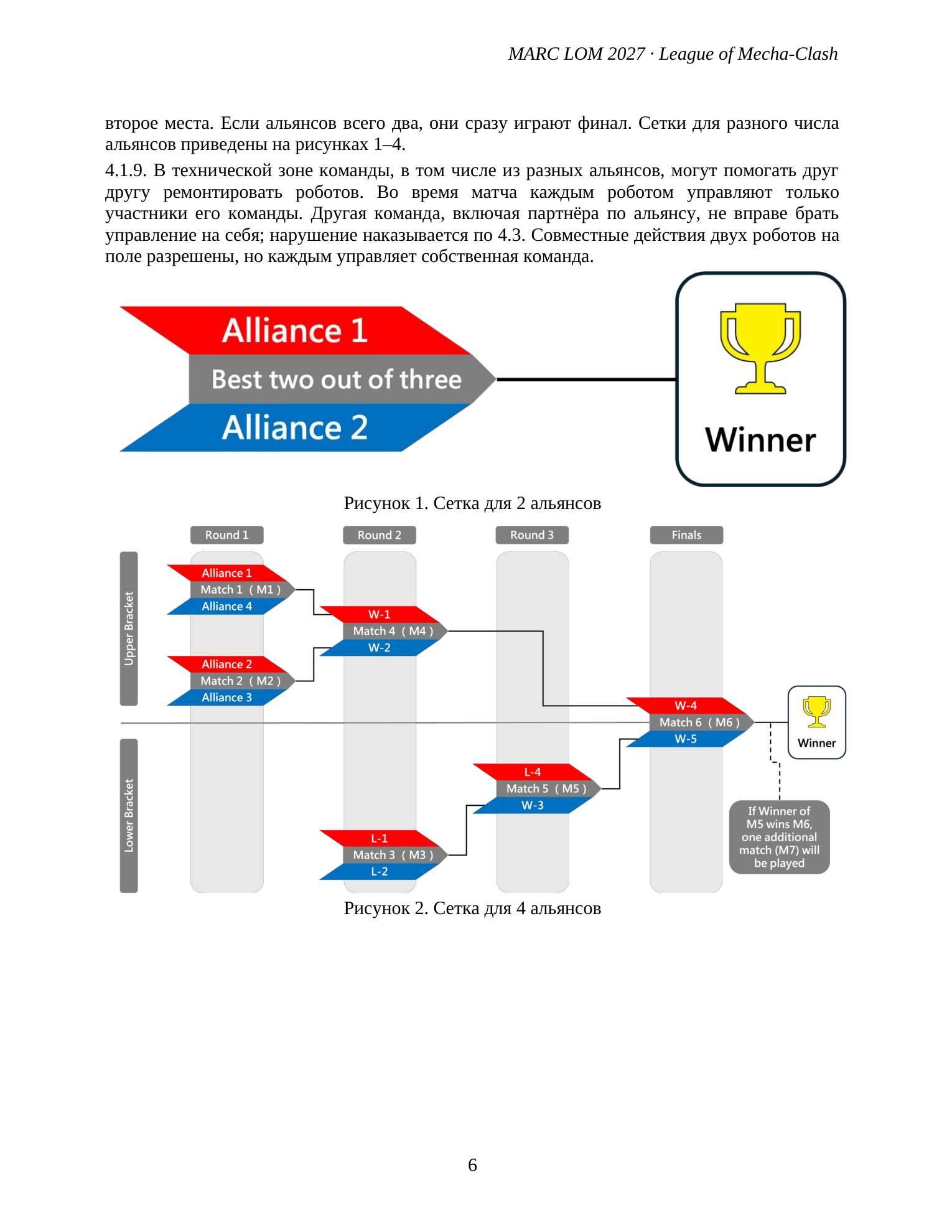
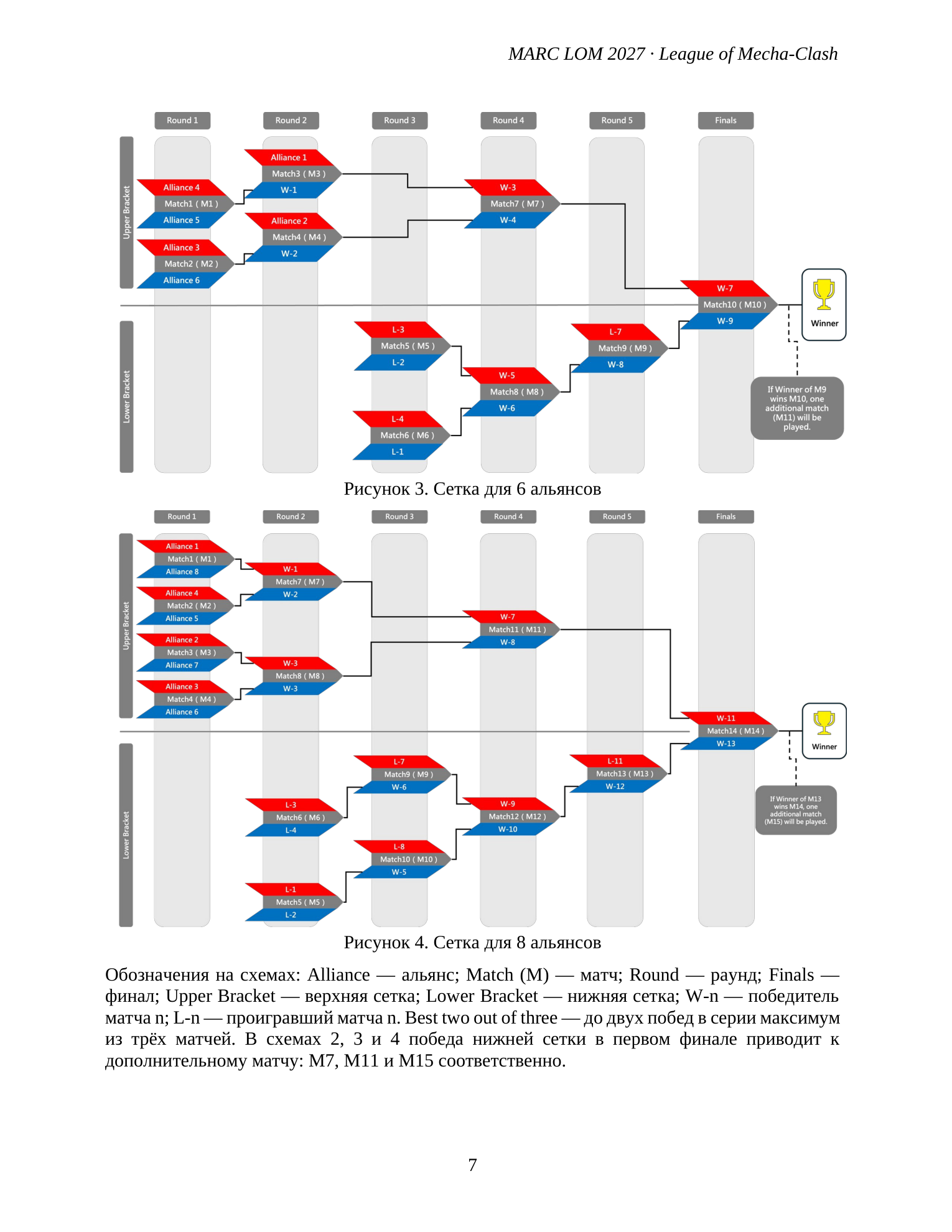
4.1.8. The playoffs use a double-elimination system. Some seeded alliances may skip the first round. Each encounter consists of one match; the results place alliances in the upper and lower brackets. If the lower-bracket alliance wins the first grand-final match, a deciding match is played for first and
Translation of the image
second places. If there are only two alliances, they proceed directly to the final. Brackets for different numbers of alliances are shown in Figures 1–4.
4.1.9. In the technical area, teams, including those from different alliances, may help one another repair robots. During a match, each robot is controlled only by members of its own team. Another team, including an alliance partner, must not take over control; a violation is penalised under 4.3. Coordinated actions by two robots on the field are permitted, but each is controlled by its own team.
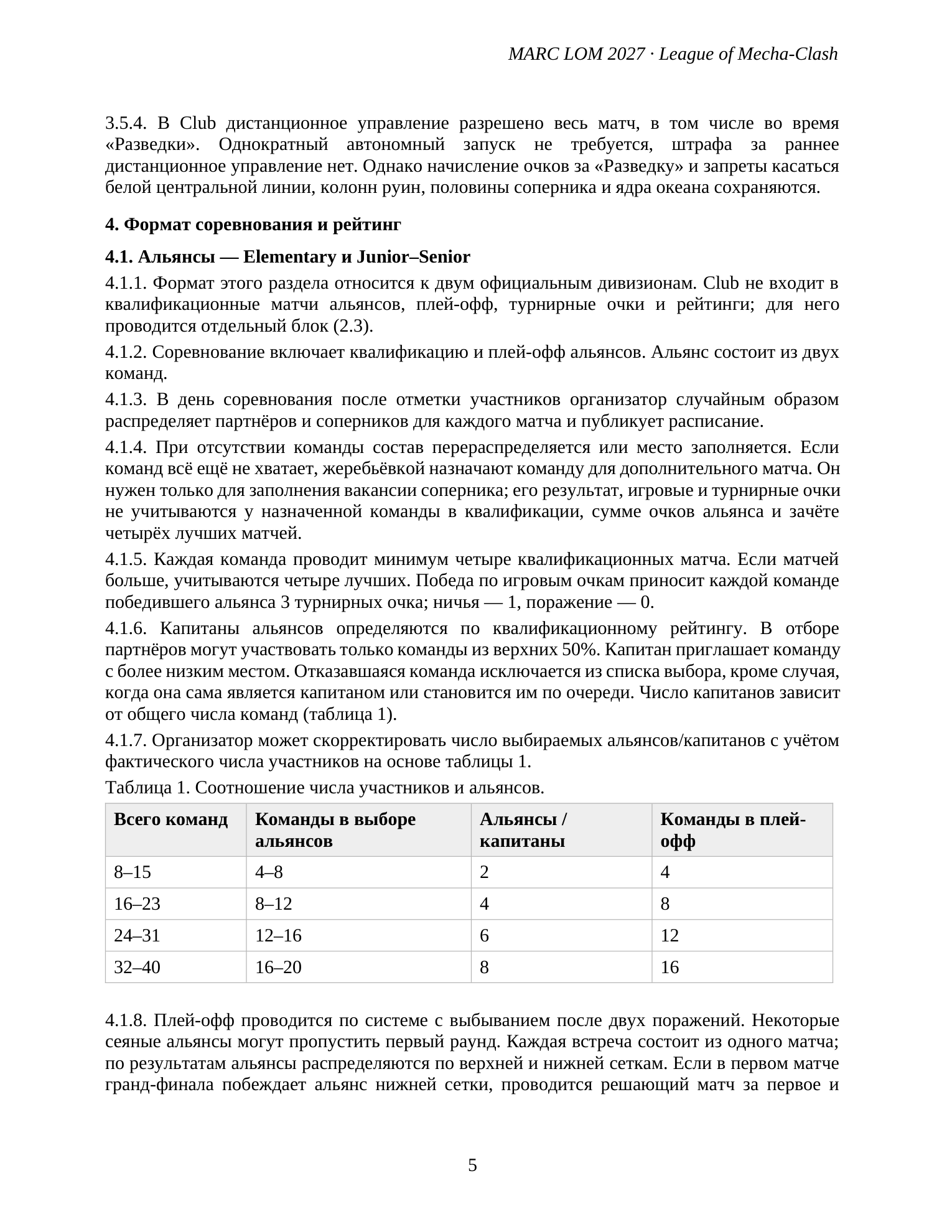
Figure 1. Bracket for 2 alliances
Alliance 1 — Best two out of three — Alliance 2 → Winner
Figure 2. Bracket for 4 alliances
Round 1 | Round 2 | Round 3 | Finals
Upper Bracket
Round 1: Alliance 1 — Match 1 (M1) — Alliance 4
Round 1: Alliance 2 — Match 2 (M2) — Alliance 3
Round 2: W-1 — Match 4 (M4) — W-2
Lower Bracket
Round 2: L-1 — Match 3 (M3) — L-2
Round 3: L-4 — Match 5 (M5) — W-3
Finals: W-4 — Match 6 (M6) — W-5 → Winner
If Winner of M5 wins M6, one additional match (M7) will be played
Translation of the image
Figure 3. Bracket for 6 alliances
Round 1 | Round 2 | Round 3 | Round 4 | Round 5 | Finals
Upper Bracket
Round 1: Alliance 4 — Match1 (M1) — Alliance 5
Round 1: Alliance 3 — Match2 (M2) — Alliance 6
Round 2: Alliance 1 — Match3 (M3) — W-1
Round 2: Alliance 2 — Match4 (M4) — W-2
Round 4: W-3 — Match7 (M7) — W-4
Lower Bracket
Round 3: L-3 — Match5 (M5) — L-2
Round 3: L-4 — Match6 (M6) — L-1
Round 4: W-5 — Match8 (M8) — W-6
Round 5: L-7 — Match9 (M9) — W-8
Finals: W-7 — Match10 (M10) — W-9 → Winner
If Winner of M9 wins M10, one additional match (M11) will be played.
Figure 4. Bracket for 8 alliances
Round 1 | Round 2 | Round 3 | Round 4 | Round 5 | Finals
Upper Bracket
Round 1: Alliance 1 — Match1 (M1) — Alliance 8
Round 1: Alliance 4 — Match2 (M2) — Alliance 5
Round 1: Alliance 2 — Match3 (M3) — Alliance 7
Round 1: Alliance 3 — Match4 (M4) — Alliance 6
Round 2: W-1 — Match7 (M7) — W-2
Round 2: W-3 — Match8 (M8) — W-3
Round 4: W-7 — Match11 (M11) — W-8
Lower Bracket
Round 2: L-3 — Match6 (M6) — L-4
Round 2: L-1 — Match5 (M5) — L-2
Round 3: L-7 — Match9 (M9) — W-6
Round 3: L-8 — Match10 (M10) — W-5
Round 4: W-9 — Match12 (M12) — W-10
Round 5: L-11 — Match13 (M13) — W-12
Finals: W-11 — Match14 (M14) — W-13 → Winner
If Winner of M13 wins M14, one additional match (M15) will be played.
Diagram labels: Alliance; Match (M); Round; Finals; Upper Bracket; Lower Bracket; W-n — winner of match n; L-n — loser of match n. Best two out of three means two wins in a series of no more than three matches. In diagrams 2, 3 and 4, a lower-bracket victory in the first final leads to an additional match: M7, M11 and M15 respectively.
Translation of the image
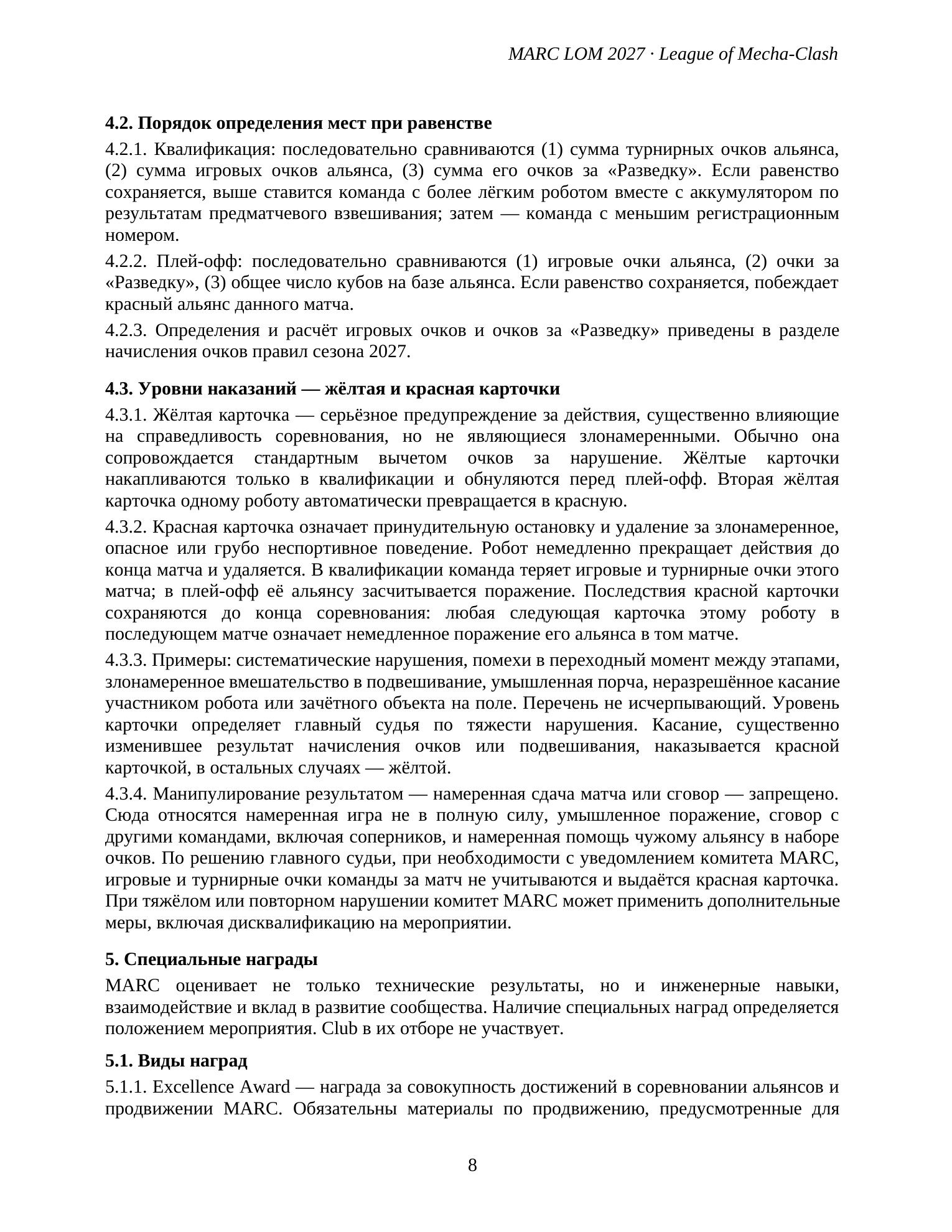
4.2. Tie-breaking procedure
4.2.1. Qualification: compare, in order, (1) the alliance’s total tournament points, (2) its total game points, and (3) its total Exploration points. If the tie remains, the team with the lighter robot including battery, as measured at the pre-match weigh-in, ranks higher; then the team with the lower registration number.
4.2.2. Playoffs: compare, in order, (1) the alliance’s game points, (2) Exploration points, and (3) the total number of cubes on the alliance base. If the tie remains, the red alliance in that match wins.
4.2.3. Definitions and calculation of game points and Exploration points are provided in the scoring section of the 2027 season rules.
4.3. Penalty levels — yellow and red cards
4.3.1. A yellow card is a serious warning for actions that significantly affect competition fairness but are not malicious. It is normally accompanied by the standard points deduction for the violation. Yellow cards accumulate only during qualification and are reset before the playoffs. A second yellow card for the same robot automatically becomes a red card.
4.3.2. A red card means forced stoppage and removal for malicious, dangerous or grossly unsporting behaviour. The robot immediately ceases action for the rest of the match and is removed. In qualification, the team loses the game and tournament points for that match; in the playoffs, its alliance is awarded a loss. The consequences of the red card remain in force until the end of the competition: any subsequent card for that robot in a later match means an immediate loss for its alliance in that match.
4.3.3. Examples include repeated violations, interference during transitions between phases, malicious interference with hanging, deliberate damage and unauthorised touching of a robot or scoring object on the field by a participant. This list is not exhaustive. The chief judge determines the card level according to the severity of the violation. Contact that significantly changes the scoring or hanging outcome is penalised with a red card; otherwise, with a yellow card.
4.3.4. Result manipulation — deliberately throwing a match or collusion — is prohibited. This includes deliberately not playing to full ability, intentional defeat, collusion with other teams including opponents, and deliberately helping another alliance score points. By decision of the chief judge, with notification to the MARC committee if necessary, the team’s game and tournament points for the match are disregarded and a red card is issued. For a severe or repeated violation, the MARC committee may impose additional measures, including disqualification from the event.
5. Special awards
MARC assesses not only technical results, but also engineering skills, collaboration and contribution to community development. The availability of special awards is determined by the event regulations. Club does not participate in their selection.
5.1. Award types
5.1.1. Excellence Award — an award for combined achievements in alliance competition and MARC promotion. The promotional materials required for the
Translation of the image
Ambassador Award are mandatory. The award is given for the highest combined assessment of strategic depth and promotional results.
5.1.2. Strategy Award — for precise competition strategy, alliance coordination, route and algorithm optimisation, offensive and defensive solutions, and interaction with a partner.
5.1.3. Rookie Award — for the strong potential of a team participating for the first time. All its members must be newcomers.
5.1.4. Ambassador Award — for active community engagement, MARC promotion, sporting behaviour and helping others.
5.2. Selection and minimum score
5.2.1. Excellence and Ambassador require separate applications; Strategy is determined through documents and an in-person interview; Rookie is determined by eligibility verification. Applications, materials, procedures and deadlines are established by the selection announcement and event regulations. The definition and verification of first-time participation are also governed by that announcement.
5.2.2. Excellence, Ambassador and Rookie require at least 90 jury points. If no one reaches the threshold, the award is not given that year. If several teams reach it, the single team with the highest total score receives it. Strategy has no minimum threshold: the best of the shortlisted teams wins; the award is withheld only if there are no candidates.
5.3. Elementary encouragement certificates
5.3.1. Based on the final qualification ranking, the top third receive gold certificates, the middle third silver, and the remainder bronze. The number of teams that completed qualification is divided by three; the numbers of gold and silver certificates are rounded down, with the remainder assigned to bronze. Exact group boundaries are announced before the event.
5.3.2. Certificates are awarded alongside alliance-placement awards, special awards and wildcards, without excluding them.
6. Additional qualification place: wildcard
6.1. A special-award winner also receives a wildcard — the right to advance to the next stage regardless of final placement in matches.
6.2. The same wildcard mechanism applies to Elementary and Junior–Senior.
6.3. Club participants are not eligible for wildcards.
6.4. The level of the next stage and allocation priority are determined by the official document “MARC 2027 Advancement & Wildcard Order (Participant Edition)”. Selection details are in the “MARC LOM 2027 Special Award Selection Announcement”.
The organiser reserves the right to change the rules and how they are applied. At the venue, official announcements and decisions take precedence.
Translation of the image
League of Mecha-Clash 2027 Season Rules
Junior–Senior · Age group: born in 2009–2015
Undersea Core Contest — “Battle for the Ocean Core”. Original version V1.0 dated 16.08.2026.
1. Season theme and task
The 2027 season theme is “Battle for the Ocean Core”. During a match lasting 2 minutes 30 seconds, alliance teams collect energy cubes and place them on their base, compete for the central ocean core and perform hanging. Pushing opponents off the field and preventing them from scoring are permitted within the rules. The alliance with the higher total score wins.
2. Field and game objects
2.1. General layout
The field is a square made of connected mats. The square bases of the red and blue alliances are located at opposite ends of one diagonal. Each alliance has two teams and two robots.
Poseidon’s trident stands in the centre, with double-cross-shaped crossbars extending towards both halves of the field. Two energy cubes hang from the crossbar on each side: one with a short hook and one with a long hook. The ocean core is located at the top, in the centre of the trident.
Each half has two starting zones. A white cross-shaped line connects them to the base and serves as a guide for line following. An energy cube is placed at the end of each guide line. Behind the starting zones is a participant zone marked in the corresponding colour. Robots must be controlled from their alliance’s zone; leaving it is permitted only in the cases specified by the rules.
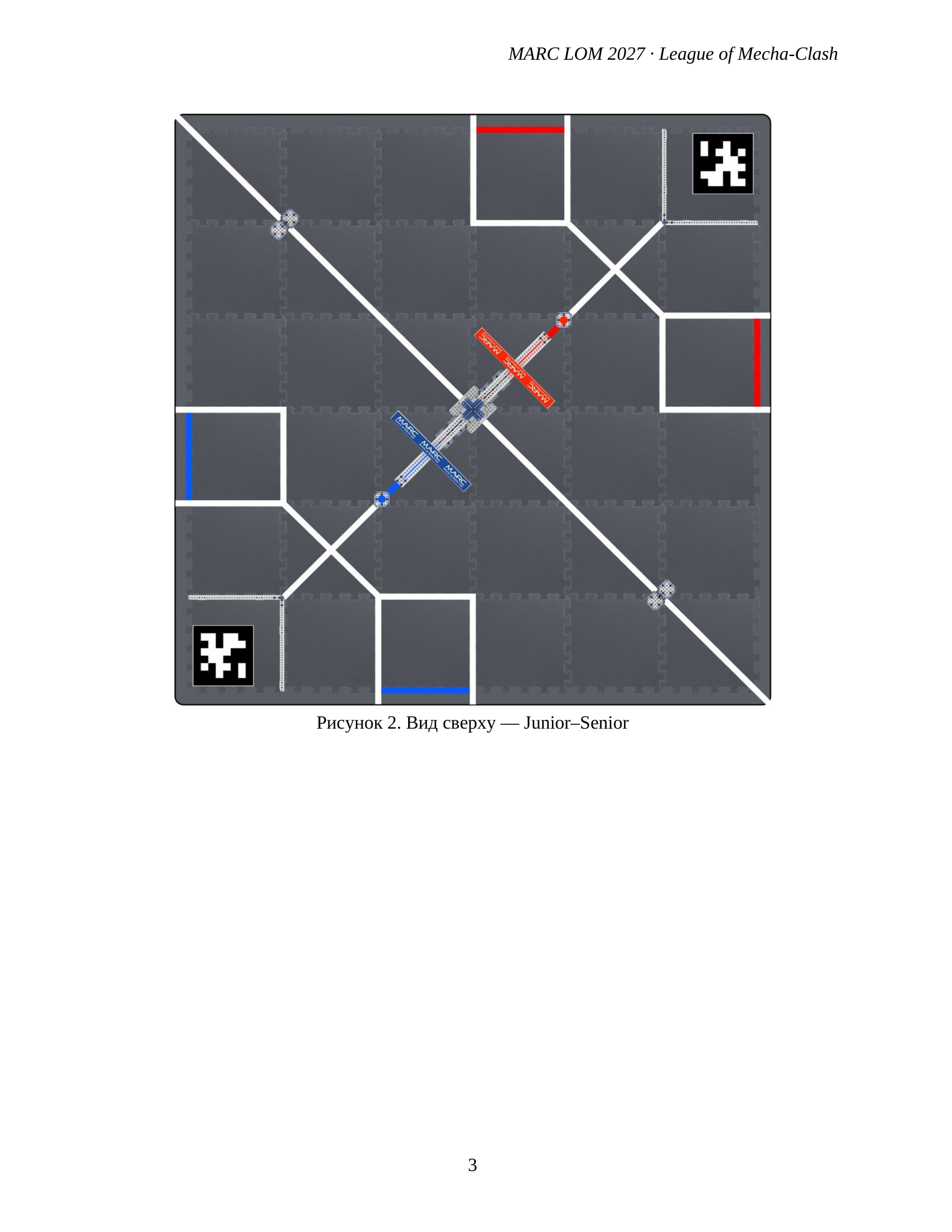
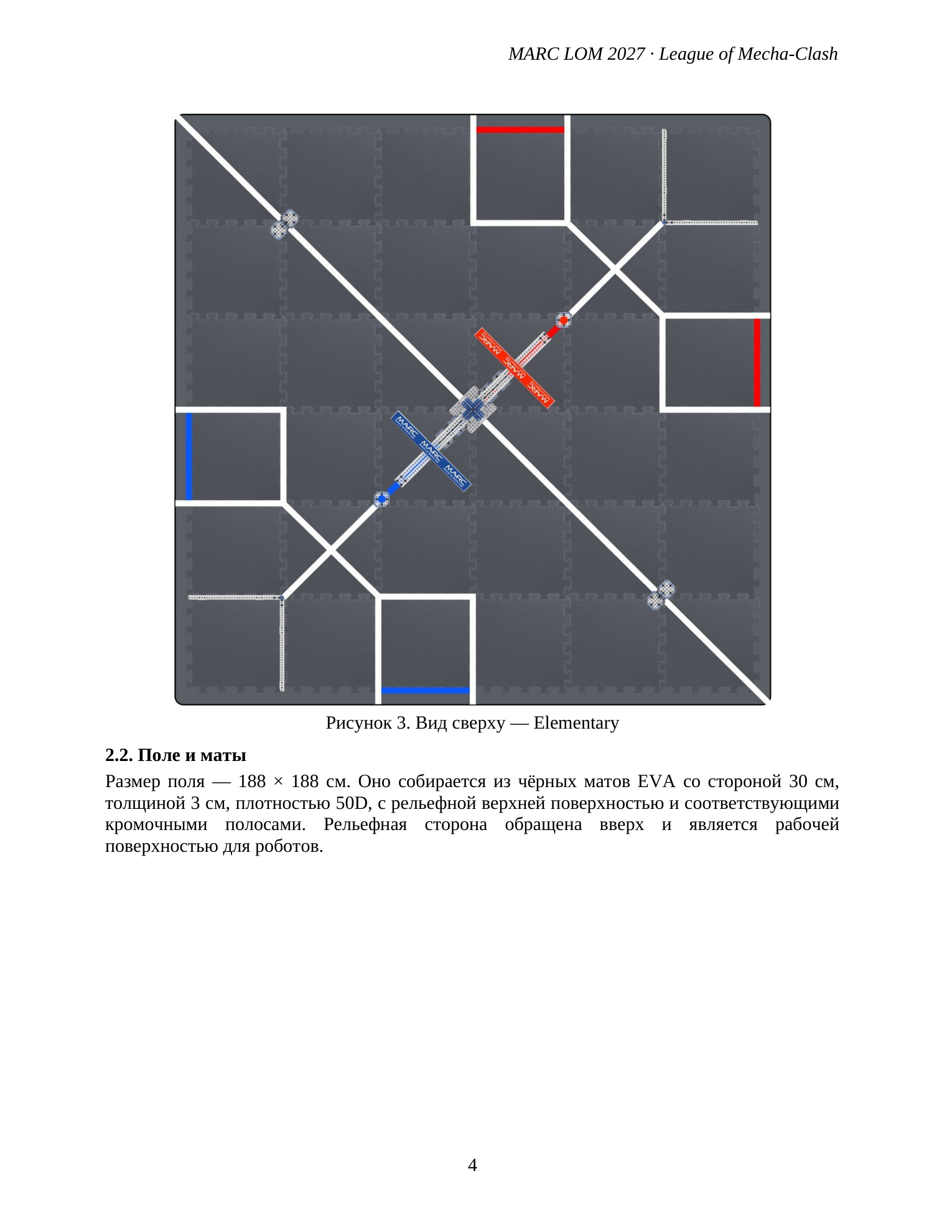
Zone names and markings are shown in Figure 1; top views for Junior–Senior and Elementary are shown in Figures 2 and 3. The field is the same. The difference: only in Junior–Senior is an AprilTag placed on the base during Exploration to specify the target cube (2.6 and 4.4).
Translation of the image
Figure 2. Top view — Junior–Senior
Translation of the image
Figure 3. Top view — Elementary
2.2. Field and mats
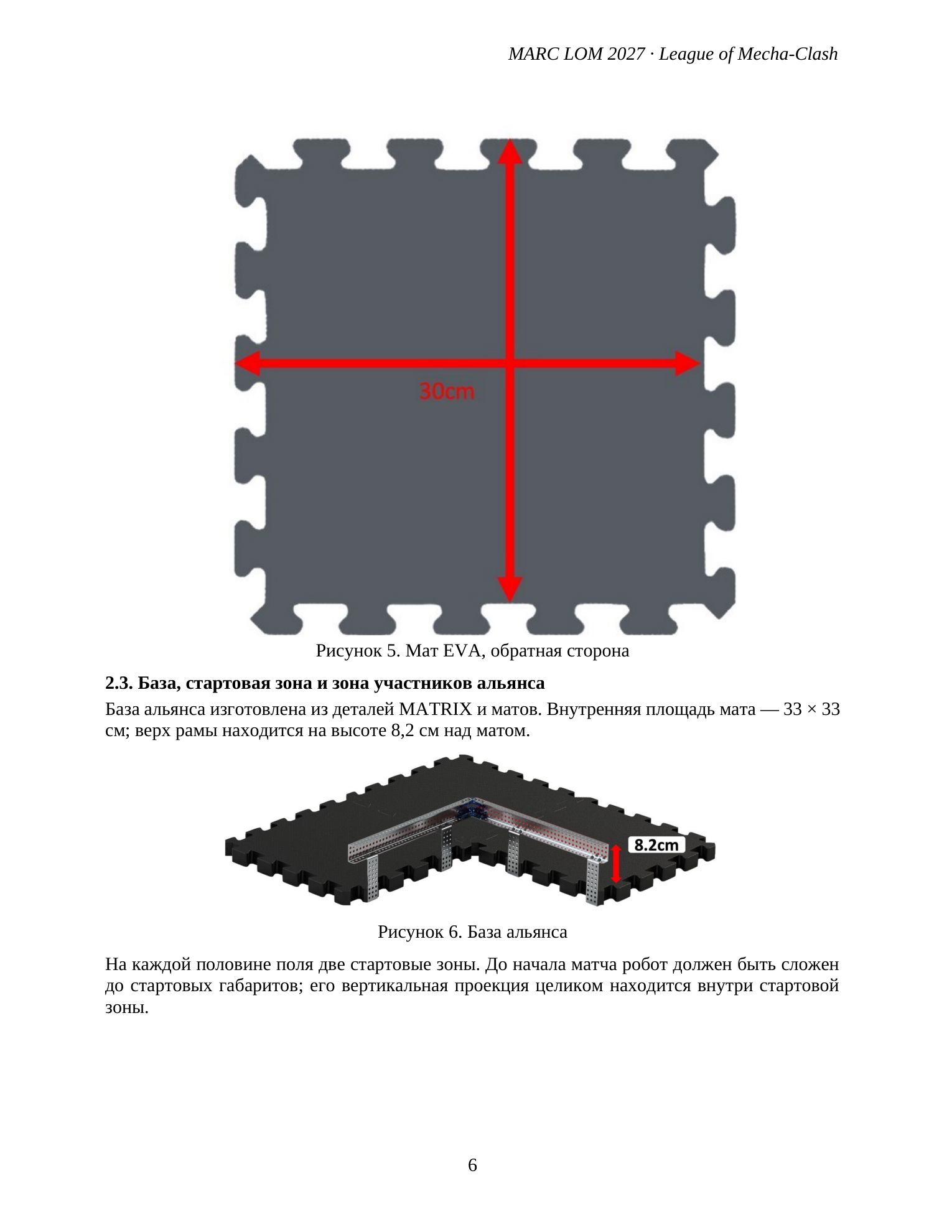
The field measures 188 × 188 cm. It is assembled from black EVA mats with a side length of 30 cm, a thickness of 3 cm, a density of 50D, a textured upper surface and corresponding edge strips. The textured side faces upwards and is the working surface for the robots.
Translation of the image
30 cm
Figure 5. EVA mat, underside
2.3. Alliance base, starting zone and participant zone
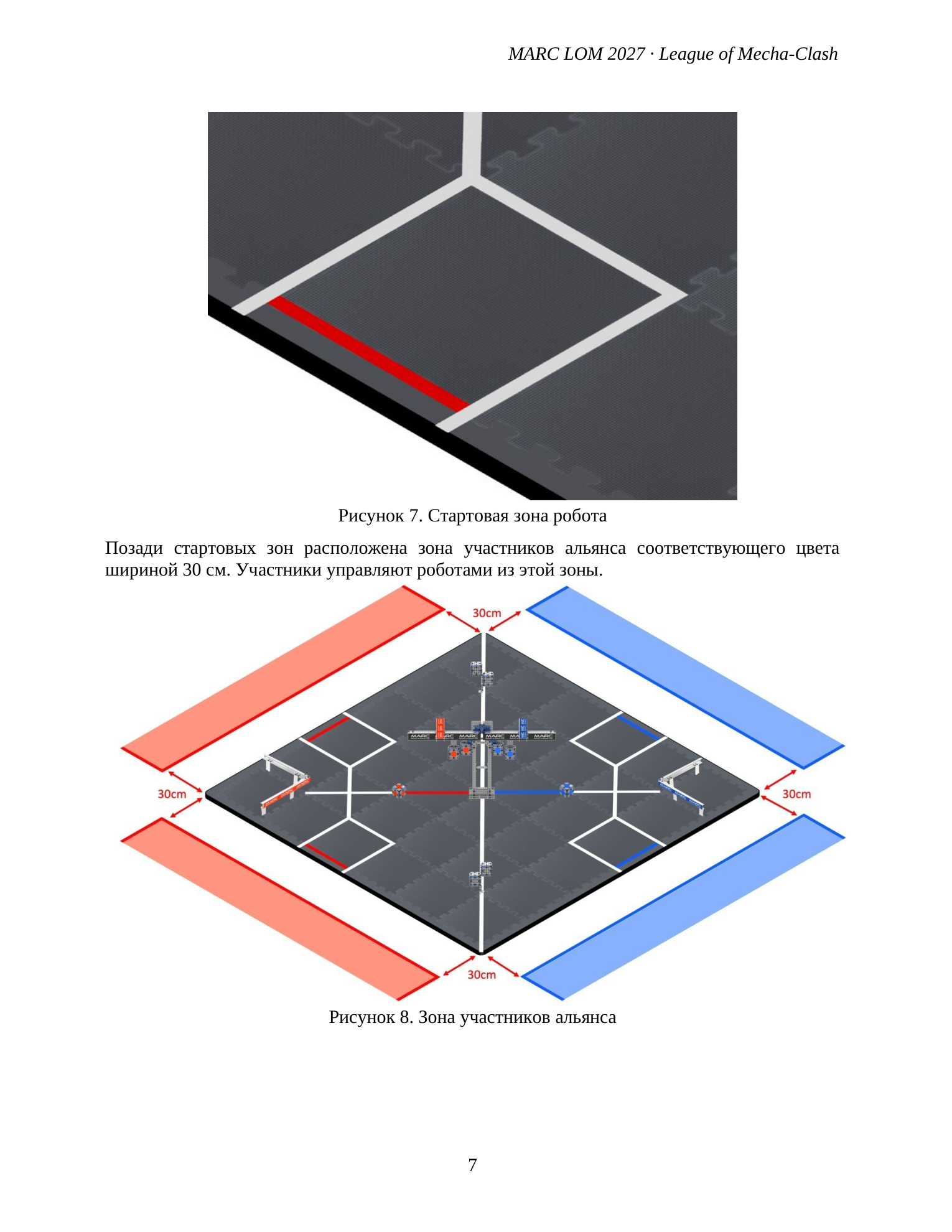
The alliance base is made from MATRIX parts and mats. The inner mat area measures 33 × 33 cm; the top of the frame is 8.2 cm above the mat.
8.2 cm
Figure 6. Alliance base
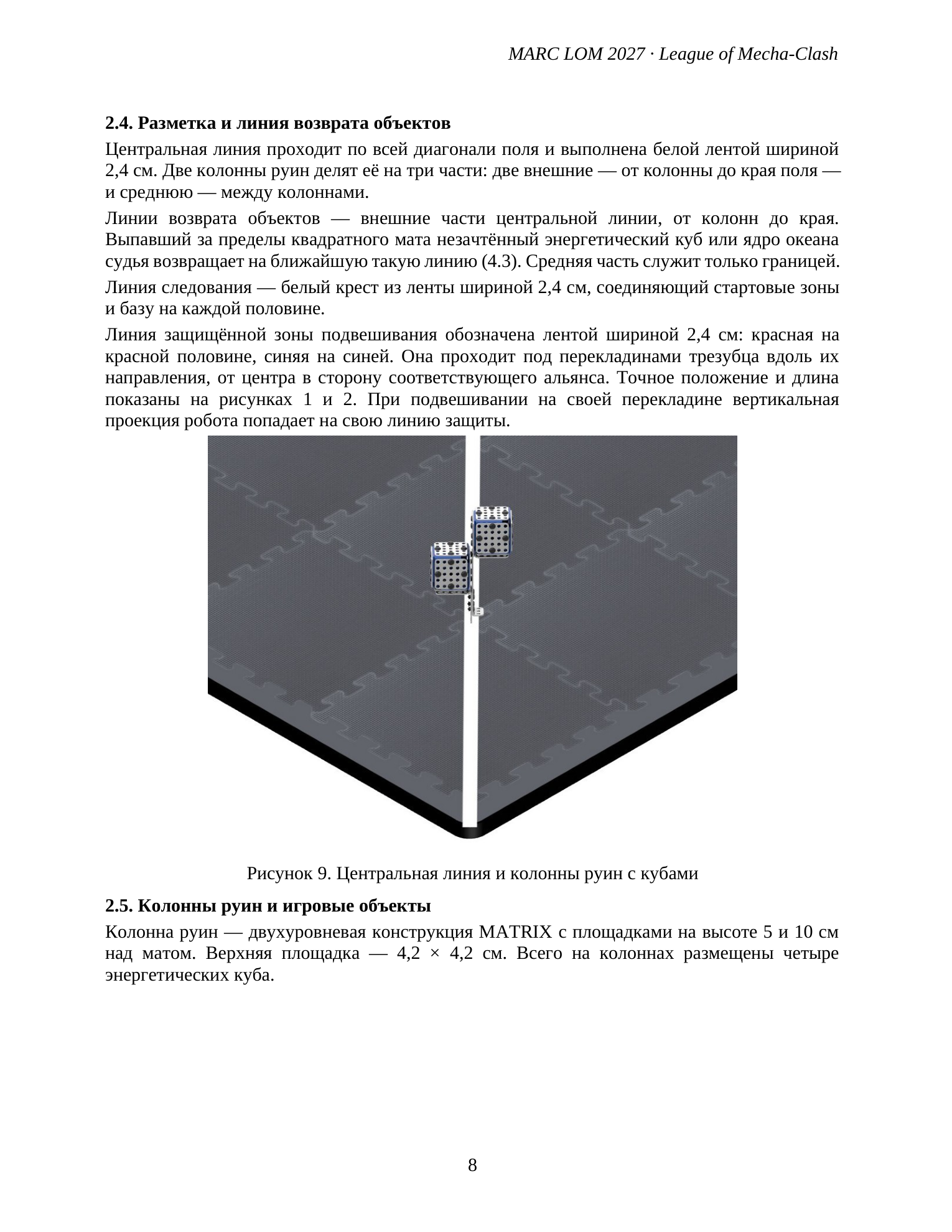
There are two starting zones on each half of the field. Before the match starts, the robot must be folded to its starting dimensions; its entire vertical projection must be inside the starting zone.
Translation of the image
Figure 7. Robot starting zone
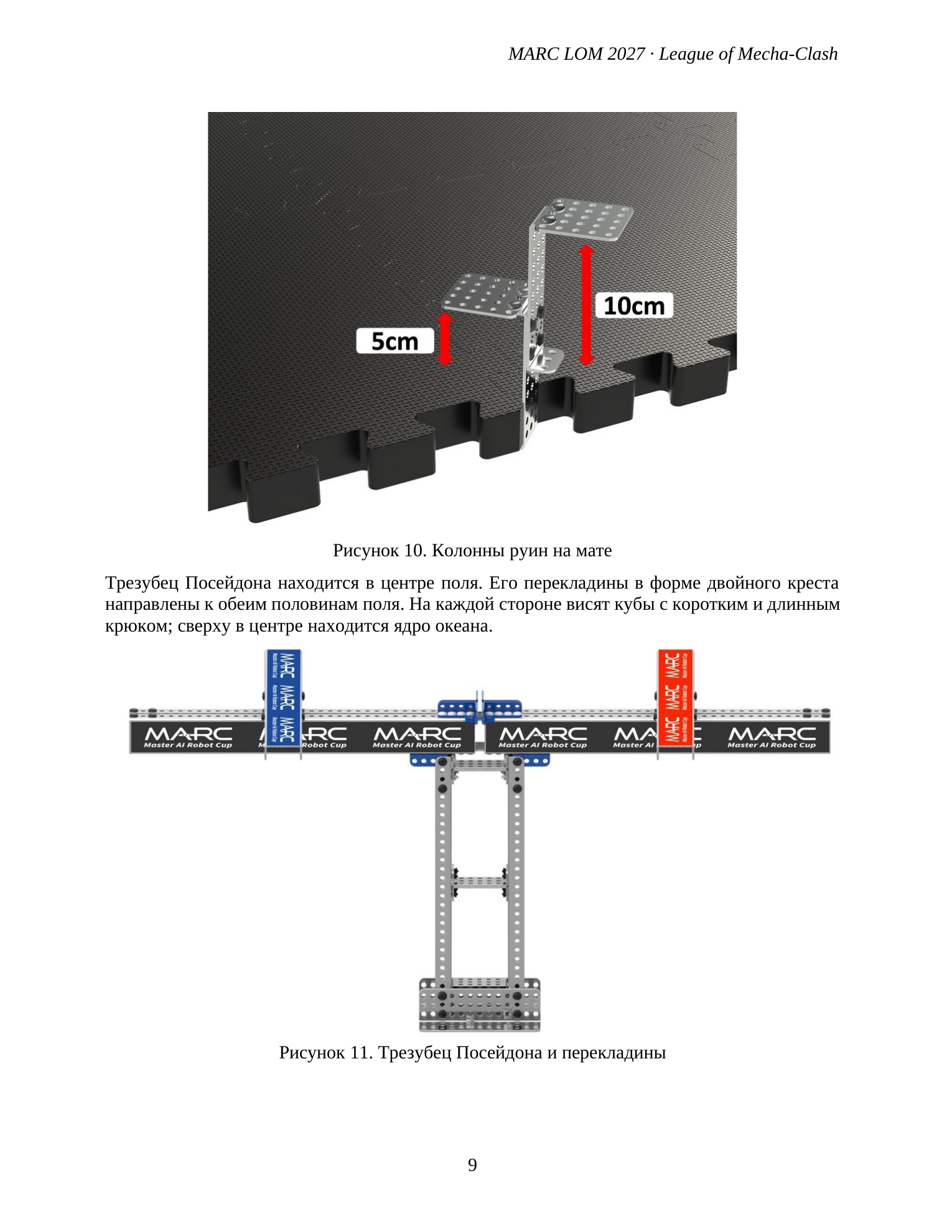
Behind the starting zones is the alliance participant zone in the corresponding colour, 30 cm wide. Participants control their robots from this zone.
30 cm; 30 cm; 30 cm; 30 cm.
Figure 8. Alliance participant zone
Translation of the image
2.4. Markings and object return line
The centre line runs along the entire diagonal of the field and is made from white tape 2.4 cm wide. Two ruin columns divide it into three sections: two outer sections, from a column to the edge of the field, and the middle section between the columns.
The object return lines are the outer sections of the centre line, from the columns to the edge. An unscored energy cube or ocean core that falls outside the square mat is returned by the referee to the nearest such line (4.3). The middle section serves only as a boundary.
The line-following line is a white cross made from tape 2.4 cm wide, connecting the starting zones and the base on each half.
The protected hanging-zone line is marked with tape 2.4 cm wide: red on the red half and blue on the blue half. It runs beneath the trident crossbars in their direction, from the centre towards the corresponding alliance. Its exact position and length are shown in Figures 1 and 2. When a robot hangs from its own crossbar, its vertical projection falls on its own protection line.
Figure 9. Centre line and ruin columns with cubes
2.5. Ruin columns and game objects
A ruin column is a two-level MATRIX structure with platforms 5 and 10 cm above the mat. The upper platform measures 4.2 × 4.2 cm. A total of four energy cubes are placed on the columns.
Translation of the image
5 cm; 10 cm
Figure 10. Ruin columns on the mat
Poseidon’s trident is located in the centre of the field. Its double-cross-shaped crossbars point towards both halves of the field. Cubes with short and long hooks hang on each side; the ocean core is at the top in the centre.
MARC — Master AI Robot Cup
Figure 11. Poseidon’s trident and crossbars
Translation of the image
MARC — Master AI Robot Cup
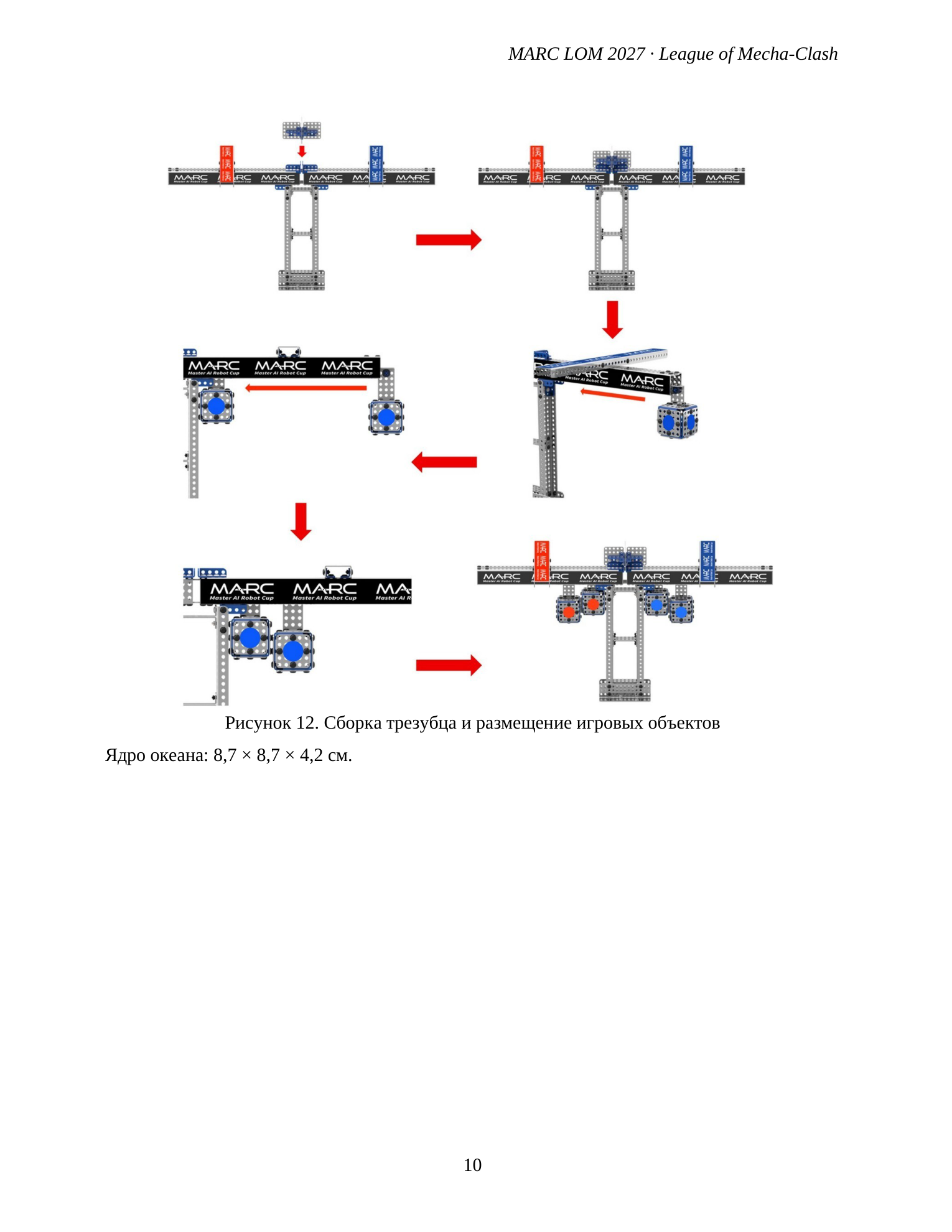
Figure 12. Trident assembly and placement of game objects
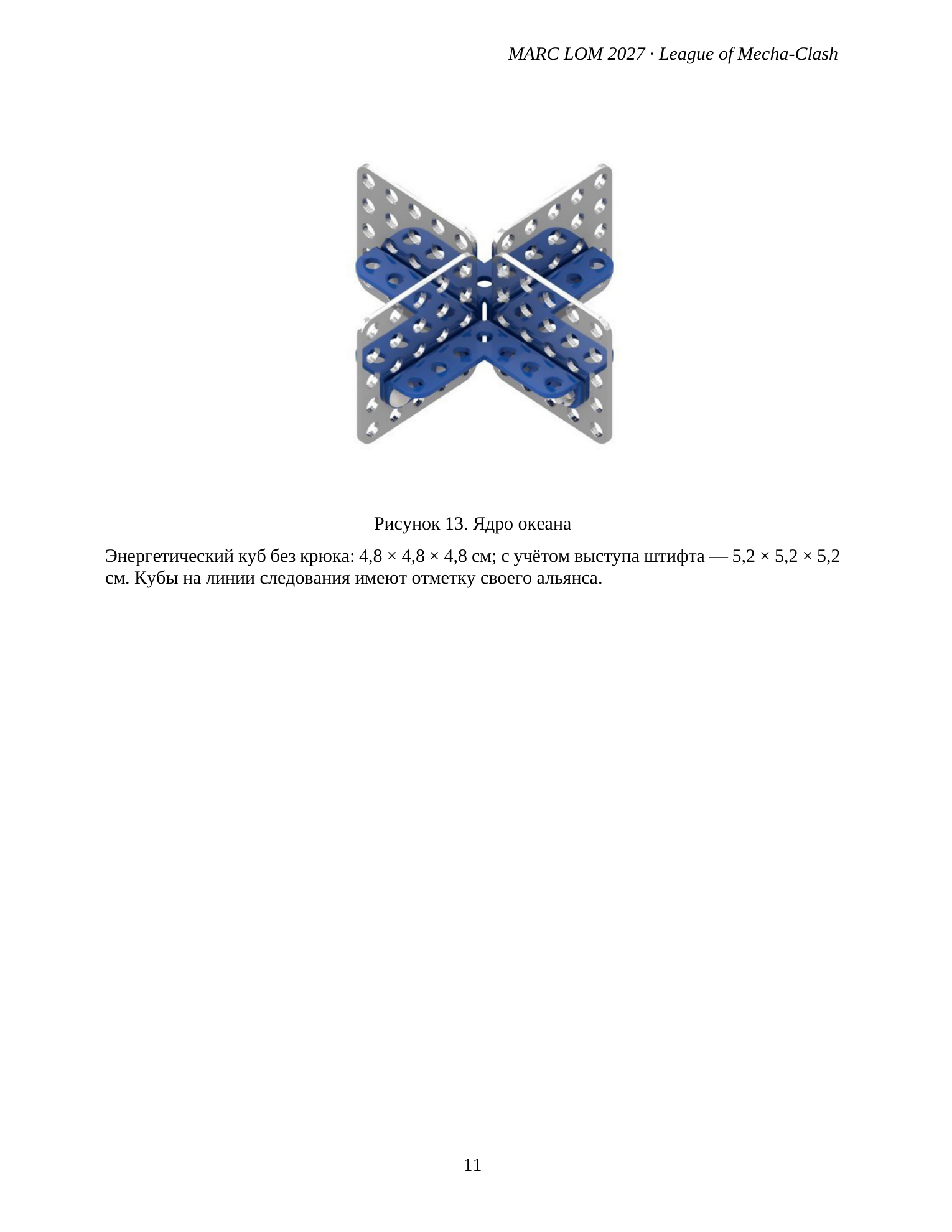
Ocean core: 8.7 × 8.7 × 4.2 cm.
Translation of the image
Figure 13. Ocean core
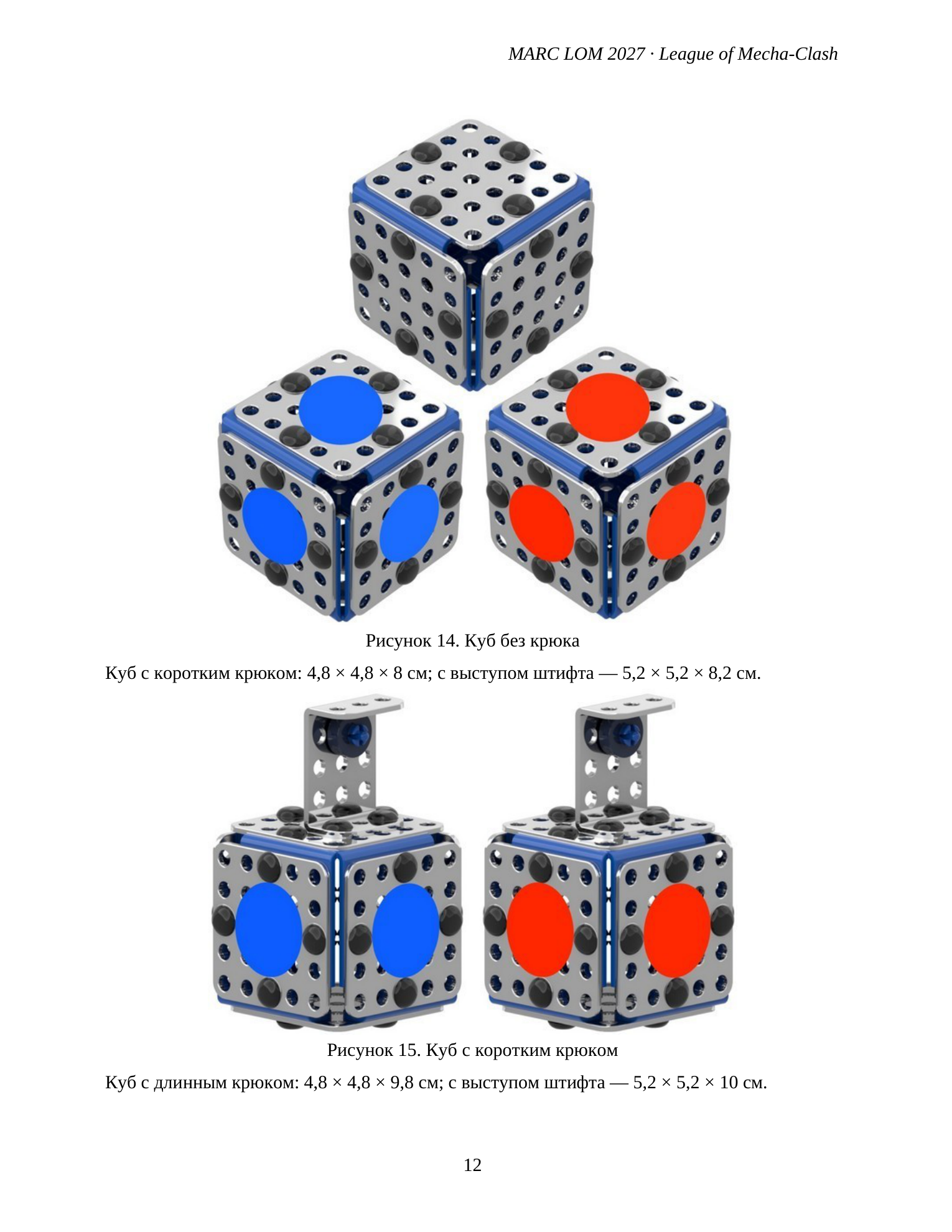
Energy cube without a hook: 4.8 × 4.8 × 4.8 cm; including the protruding pin: 5.2 × 5.2 × 5.2 cm. Cubes on the line-following line bear their alliance’s mark.
Translation of the image
Figure 14. Cube without a hook
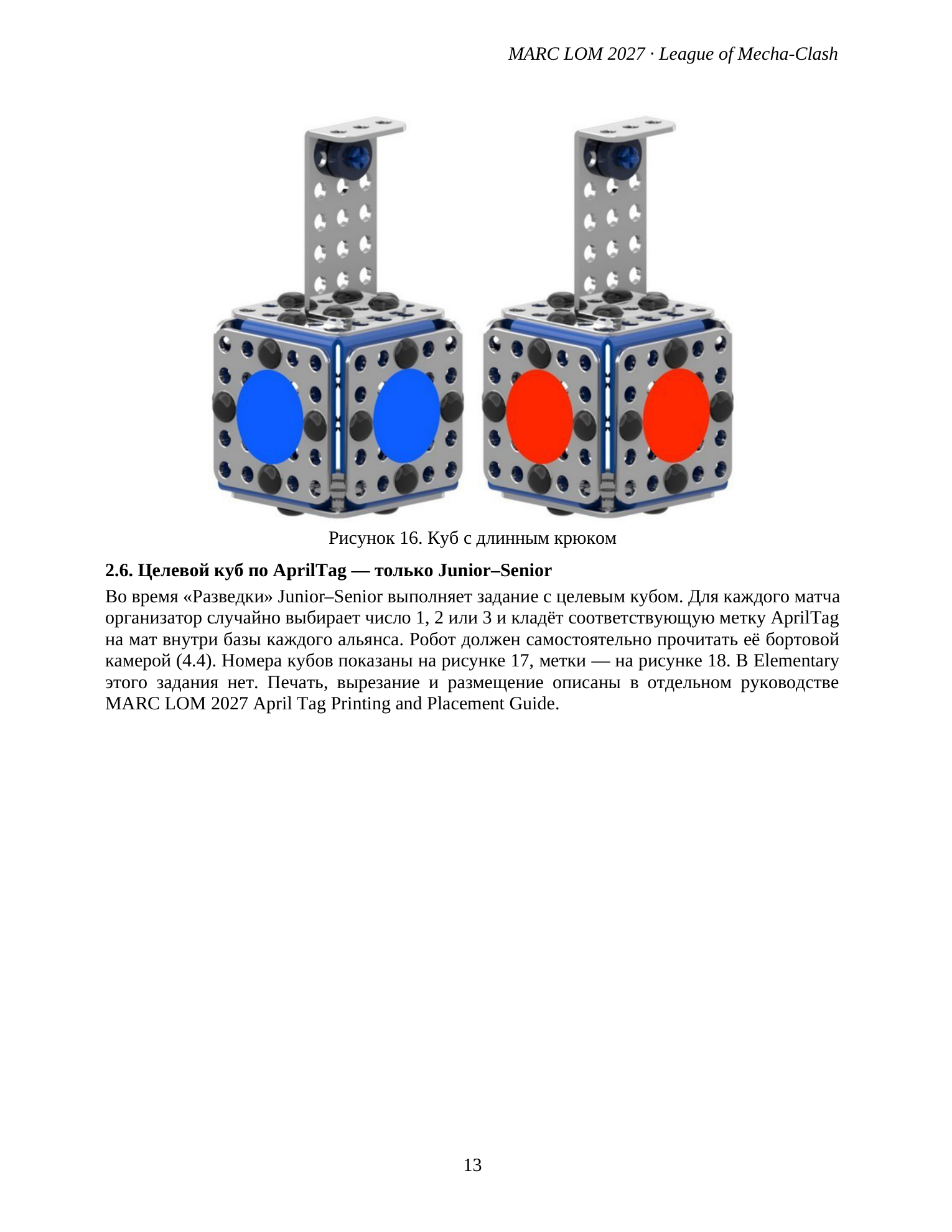
Cube with a short hook: 4.8 × 4.8 × 8 cm; including the protruding pin: 5.2 × 5.2 × 8.2 cm.
Figure 15. Cube with a short hook
Cube with a long hook: 4.8 × 4.8 × 9.8 cm; including the protruding pin: 5.2 × 5.2 × 10 cm.
Translation of the image
Figure 16. Cube with a long hook
2.6. AprilTag target cube — Junior–Senior only
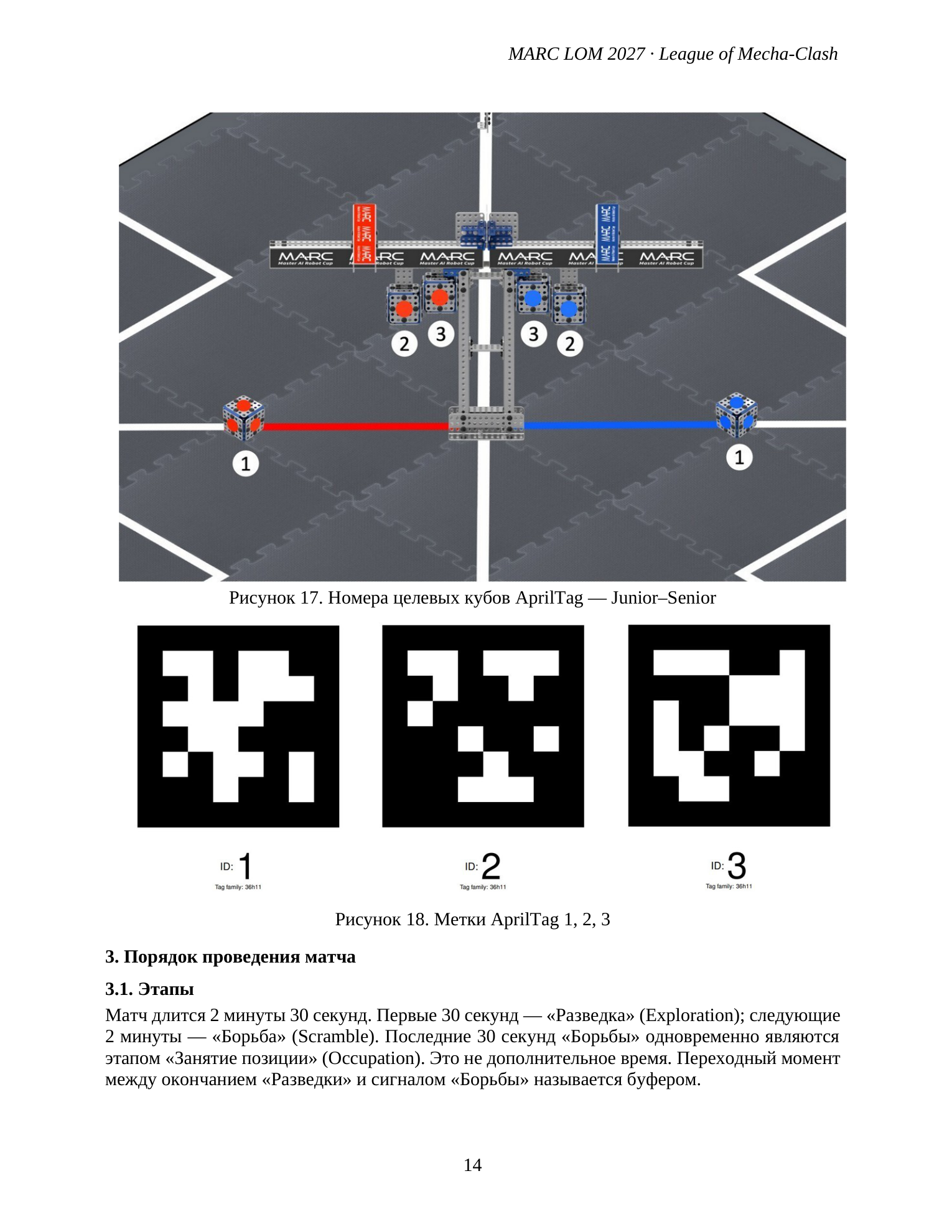
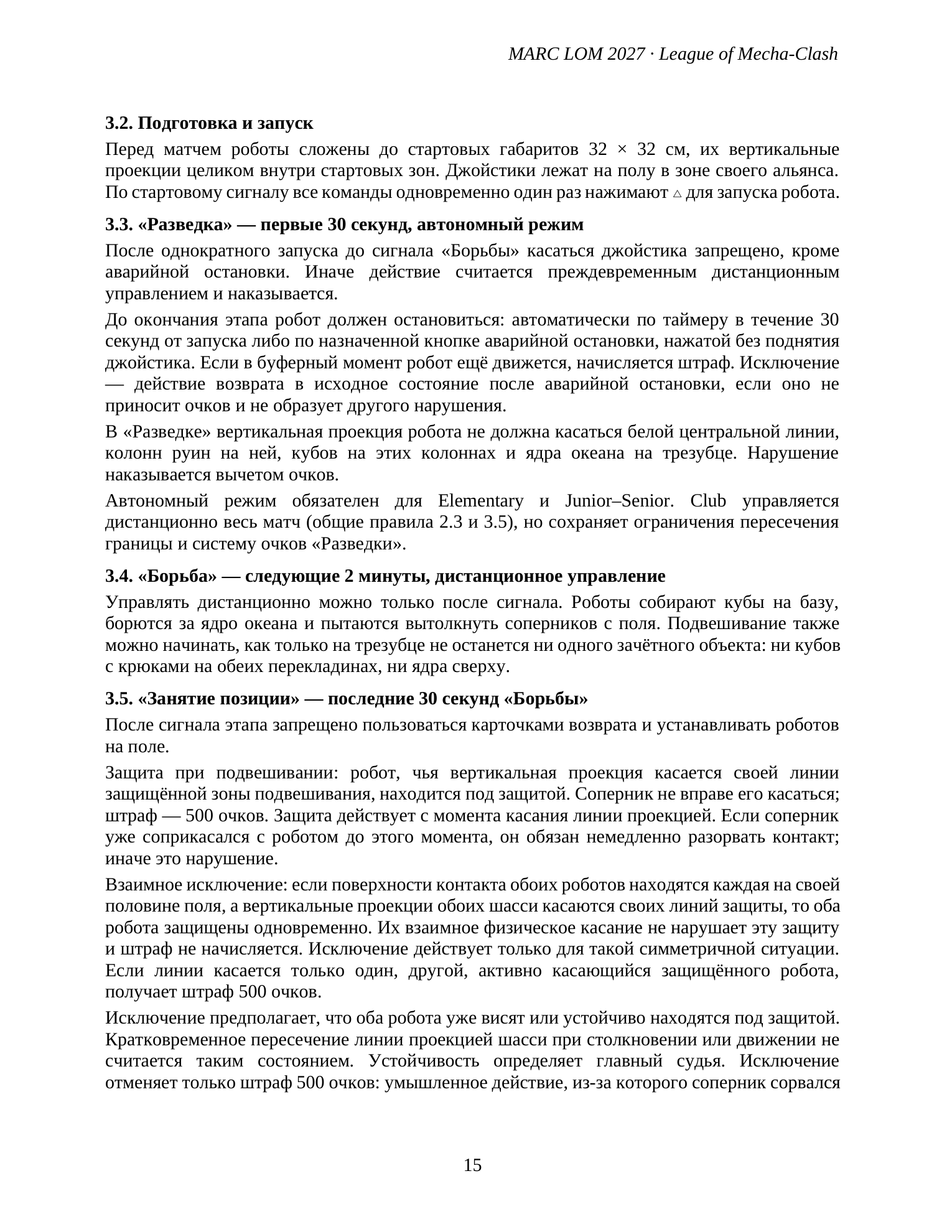
During Exploration, Junior–Senior performs the target-cube task. For each match, the organiser randomly selects the number 1, 2 or 3 and places the corresponding AprilTag on the mat inside each alliance’s base. The robot must read it independently using its onboard camera (4.4). Cube numbers are shown in Figure 17 and tags in Figure 18. Elementary does not have this task. Printing, cutting and placement are described in the separate MARC LOM 2027 AprilTag Printing and Placement Guide.
Translation of the image
MARC — Master AI Robot Cup. Target cube numbers: 1, 2, 3 for each alliance.
Figure 17. AprilTag target cube numbers — Junior–Senior
ID: 1; ID: 2; ID: 3. Tag family: 36h11.
Figure 18. AprilTags 1, 2, 3
3. Match procedure
3.1. Stages
A match lasts 2 minutes 30 seconds. The first 30 seconds are Exploration; the following 2 minutes are Scramble. The last 30 seconds of Scramble are also the Occupation stage. This is not additional time. The transition between the end of Exploration and the Scramble signal is called the buffer.
Translation of the image
3.2. Preparation and start
Before the match, robots are folded to the starting dimensions of 32 × 32 cm, with their vertical projections entirely inside the starting zones. Joysticks lie on the floor in the respective alliance's area. At the start signal, all teams simultaneously press △ once to start their robots.
3.3. ‘Exploration’ — the first 30 seconds, autonomous mode
After the single start action, touching the joystick before the ‘Scramble’ signal is prohibited, except for an emergency stop. Otherwise, the action is considered premature remote control and is penalized.
The robot must stop before the end of the stage: either automatically by a timer within 30 seconds of starting, or using the designated emergency-stop button, pressed without lifting the joystick. If the robot is still moving during the transition interval, a penalty is imposed. An exception applies to an action that returns the robot to its initial state after an emergency stop, provided that it earns no points and constitutes no other violation.
During ‘Exploration’, the robot's vertical projection must not touch the white centre line, the ruin columns on it, the cubes on those columns, or the Ocean Core on the trident. A violation results in a points deduction.
Autonomous mode is mandatory for Elementary and Junior–Senior. Club uses remote control throughout the match (General Rules 2.3 and 3.5), but retains the boundary-crossing restrictions and the ‘Exploration’ scoring system.
3.4. ‘Scramble’ — the next 2 minutes, remote control
Remote control is permitted only after the signal. Robots collect cubes in their base, compete for the Ocean Core and attempt to push opponents off the field. Hanging may also begin as soon as no scoring object remains on the trident: neither hooked cubes on either crossbar nor the core on top.
3.5. ‘Occupation’ — the last 30 seconds of ‘Scramble’
After the stage signal, using Reset Cards and placing robots on the field are prohibited.
Hanging protection: a robot whose vertical projection touches its own protected hanging-zone line is protected. An opponent may not touch it; the penalty is 500 points. Protection begins when the projection touches the line. If an opponent was already in contact with the robot before that moment, it must break contact immediately; otherwise, this is a violation.
Mutual exception: if the contact surfaces of both robots are each on their own half of the field, and the vertical projections of both chassis touch their respective protection lines, both robots are protected simultaneously. Physical contact between them does not violate this protection, and no penalty is imposed. The exception applies only to this symmetrical situation. If only one robot touches its line, the other robot that actively touches the protected robot receives a 500-point penalty.
The exception assumes that both robots are already hanging or are stably in a protected position. A brief crossing of the line by the chassis projection during a collision or movement does not qualify. The head referee determines whether the position is stable. The exception waives only the 500-point penalty: a deliberate action that causes an opponent to fall
Translation of the image
from its hanging position may still result in a card for malicious interference with hanging under General Rules 4.3, up to and including an immediate red card.
3.6. End of the match
The match ends at the audible signal; points and the result are determined under Section 5. If both alliances confirm that no further scoring or changes in points will occur, the referee may end the match early.
4. Performing the tasks
4.1. Controlling and placing energy cubes
Each robot may control or hold only one energy cube at a time. Two or more constitute a violation.
A cube is considered controlled if, as a result of the robot's actions, it leaves its initial position and moves together with the robot: when grasped, transported, hooked, pushed from underneath or simply pushed. Pushing with the robot's body without grasping also counts as control. Touching by a stationary robot without moving the cube does not count as control, nor does brief contact that moves the cube while the robot is moving, provided that the cube does not continue moving with the robot in the same direction: for example, the robot merely leans against it or brushes it in passing.
The sole exception is removing cubes from the trident crossbar: several cubes may be touched. However, after one cube has been removed and has left the trident, the robot must return to controlling one cube within 2 seconds. Holding a second cube beyond this time is considered excess control (5.2).
Successful placement: the body of the cube touches the mat inside the square base, and the robot no longer grasps, controls or supports it. If, when the match ends, any part of an alliance's robot supports a cube in its own base or restricts the cube's position, that cube's placement does not count.
As soon as the cube's body, excluding its hook, touches the mat inside the base, an opponent may not take it away. If an opposing robot directly removes the cube, the referee returns it to the mat inside that base.
4.2. Reset Card and protection after return
Each robot is allowed a maximum of one Reset Card per match. It permits the robot to return through either of its alliance's two starting zones.
If a robot is pushed off or falls off the square mat, the team immediately puts down its joystick. Before returning, it must wait until the referee determines that the robot is no longer inseparably entangled with robots on the field. The card is then handed to the referee, and the robot is placed in either of its own starting zones. The head referee determines the degree of entanglement on site.
Protection after return ends at whichever event occurs first: 5 seconds have elapsed since placement, or the robot's vertical projection no longer fits entirely within the starting zone — the robot has left it. While protection applies, directly or indirectly touching the protected opponent and continuing to push it are penalized; forced contact resulting from the opposing alliance's actions is an exception.
For a valid return placement, all driven wheels must contact the mat inside the robot's own starting zone within their vertical projections. For tracks,
Translation of the image
contact with the mat inside the zone by part of the left track and part of the right track is sufficient. If the robot is released or starts moving while at least one driven wheel or track is not in contact with the mat inside the zone, the robot is forcibly stopped and removed. Whether protection is retained is assessed separately: the robot's entire vertical projection must be inside the zone. These two criteria are independent.
If an opponent's illegal collision during protection knocks the robot off the field, the affected robot is not eliminated and may immediately return to its own starting zone without additional conditions. Each repeated placement starts a new 5-second protection period; the number of repetitions is unlimited until the robot safely leaves or one full five-second interval passes without an illegal push-out. However, at the ‘Occupation’ signal, all returns and placements cease, including this unconditional return.
During ‘Exploration’ and after the ‘Occupation’ signal, Reset Cards and robot placement are prohibited. A card that has been handed over is not returned, regardless of whether the return succeeds. Touching a robot without handing the card to the referee is considered touching a field object and results in the robot being forcibly stopped and removed.
Figure 19. Reset Card, red card and yellow card
TEAM 1 / TEAM 2 — team 1 / team 2. The arrows indicate a robot's return; the yellow and red cards indicate penalty levels.
4.3. Objects that fall out and actions on the field
If an unscored energy cube or the Ocean Core falls beyond the square mat, the referee places the object on the nearest return line — the outer segment of the centre line from the column to the edge. The clock is not stopped.
If a cube or the core was already entirely inside a base: (1) when the alliance's own team accidentally, or under pressure, pushes the object out of the base, either alliance may capture it again; if it falls over the edge, it is placed on the nearest return line; (2) when an opposing robot removes the object, the referee returns it to its previous base.
Translation of the image
If an inadequately secured battery or battery pack becomes detached on the field, the robot is forcibly stopped and removed for safety reasons.
4.4. AprilTag target cube — Junior–Senior only
After the robots of both alliances have been placed in their starting zones and the joysticks have been placed on the floor in their respective areas, the organizer randomly selects one tag, 1, 2 or 3 — the same throughout the field — and places it inside each base. The robots are then started with a single press of the △ button. Because the draw takes place after preparation, participants may only press △ after the draw. They may not manually change or preselect the target using switches, program replacement or selection, external input, etc. The robot reads the AprilTag itself using its onboard camera and determines the target cube.
The number identifies a cube on the alliance's own half: 1 — the cube on the mat at the end of the line-following path; 2 — the outer cube on the trident crossbar, with a long hook; 3 — the inner cube, with a short hook.
During ‘Exploration’, the scoring zone for the target cube changes: instead of the base, it must be placed in either of the alliance's own starting zones before the stage ends. Success is determined by the cube's body touching the mat inside the starting zone without being grasped or supported by a robot; the contact-surface criterion is the same as for the base.
The alliance has one target cube, and its two teams coordinate the task. The task applies only during ‘Exploration’. Once ‘Scramble’ begins, it cannot be completed retrospectively or earn points.
Placing the target cube in the base or elsewhere earns no placement points for ‘Exploration’. If target cube No. 2 or No. 3 was hanging on the trident, its removal still earns 100 points, which are added to the 400 points for the starting zone. Example: a target cube removed from the trident and placed in a starting zone by the end-of-‘Exploration’ signal earns 100 + 400 = 500 points.
Other, non-target cubes are scored normally: 300 points each for placement in the base during ‘Exploration’. Elementary does not perform this task; its normal ‘Exploration’ placement rules remain unchanged.
At the end of ‘Exploration’, the alliance receives 400 points for the target cube in its own starting zone. If it has not placed the cube there, it loses 200 points (Section 5).
5. Scoring and result
5.1. Scoring
At the end-of-‘Exploration’ signal:
• Each cube removed from the trident — 100 points.
• Each cube successfully placed in the base — 300 points.
• The AprilTag target cube in the alliance's own starting zone — 400 points; Junior–Senior only, under 4.4.
At the end-of-match signal:
• The Ocean Core successfully placed in the base — 300 points.
• Each cube successfully placed in the base — 100 points, independently of ‘Exploration’ points. For example, a cube is removed from the trident and placed in the base during ‘Exploration’, and remains in the base at the end of the match: 100 for removal + 300 for early placement + 100 for final placement = 500.
Translation of the image
• Each robot that has fallen or been pushed off the square mat by the end of the match gives the opposing alliance 50 points.
• Hanging: one or two robots are completely off the mat, and the alliance's entire hanging structure, including all lifted robots, is supported only by the trident crossbar. Each successfully lifted robot earns the alliance 400 points.
• Two-robot bonus: at the end-of-‘Occupation’ signal, both robots of one alliance are hanging from their own crossbar and meet the scoring conditions — an additional 200 points.
• Final position: a robot has not met the conditions for a scoring hang, but its vertical projection is on its own protected-zone line and it has not crossed the white centre line onto the opponent's half — 100 points per robot. If hanging has already been scored, these additional 100 points are not awarded.
• Each used Reset Card gives the opponent 50 points.
5.2. Deductions
• Controlling more than one cube: minus 100 for each extra cube. If points are earned in doing so, an additional minus 150 for each illegally scored cube.
• During ‘Exploration’, the projection touches the white centre line, columns on it, or the space above the Ocean Core, but no objects on the opponent's half are touched: minus 100. If an object on the opponent's half — a cube or robot — is also touched: minus 300.
• Premature remote control or continued movement before the ‘Scramble’ signal: minus 100 per occurrence.
• Touching an opponent under return protection without causing it to fall: minus 100; if it falls off the field: minus 300.
• Illegal early hanging: before the last 30 seconds begin, hanging is prohibited while any scoring object remains on the trident, including cubes on either crossbar and the core on top. Touching the crossbar with the robot's structure in an attempt to transfer its own weight to it for hanging: minus 200.
• During ‘Occupation’, touching a protected robot whose projection touches its own protection line: minus 500. Mutual contact between two protected robots in the symmetrical situation under 3.5 is exempt from this penalty.
• The AprilTag target cube is not placed in the alliance's own starting zone during ‘Exploration’: minus 200, Junior–Senior only (4.4).
5.3. Determining the result
After 2 minutes 30 seconds, the alliance with the higher total score wins. Equal scores result in a draw. If time has expired, neither alliance has scored points, and both have lost the ability to move, a draw is also recorded.
5.4. Summary table
Table 1. Points for the 2027 season.
Action or condition — Points
Cube removed from the trident, each, by the end of ‘Exploration’ — +100
Cube placed in the base during ‘Exploration’, each — +300
Translation of the image
Action or condition — Points
Target cube in the alliance's own starting zone, Junior–Senior only — +400
Cube in the base at the end of the match, each — +100
Ocean Core in the base — +300
Successfully hanging robot, each — +400
Both robots successfully hanging, bonus — +200
At the end, the robot is not hanging, its projection is on its own protection line, and it has not crossed onto the opponent's half — +100
Robot has fallen or been pushed off the field, each; points awarded to the opponent — +50
Reset Card used; points awarded to the opponent — +50
Extra controlled cube, each — −100
Cube scored while exceeding the control limit, additional penalty for each — −150
Premature remote control, each occurrence — −100
Violation of the central boundary during ‘Exploration’ without touching the opponent's objects — −100
The same, with contact with an object on the opponent's half — −300
Touching an opponent under return protection without causing a fall — −100
The same, causing a fall off the field — −300
Illegal early hanging — −200
Violation of hanging protection — −500
Target cube not in the alliance's own starting zone, Junior–Senior only — −200
6. Preliminary selection documents
The need for a preliminary review is determined by the event regulations. If one is conducted, the project description includes the scoring strategy, alliance cooperation and mechanism design. This section of the original specifies a length of up to four pages, excluding the title page and table of contents.
Strategy: explain scoring in autonomous ‘Exploration’ and the corresponding hardware and software functions, such as line following or sensor recognition; program screenshots may be attached. Describe the joystick button assignments for the manual stage, the strategy for all three stages, and actions in unexpected situations.
Alliance cooperation: describe the allocation of scoring and defensive roles in one playoff match and the factors used to choose those roles.
Mechanisms: describe solutions specific to this competition — chassis, manipulator, gripper, storage mechanism, ballast, sensors, etc. Elementary teams using non-MATRIX parts and
Translation of the image
adapters additionally explain the connection method; the requirements of Section 3 of the General Rules remain in force.
Upload deadlines, the project-description format, applications and materials for special awards are determined primarily by the MARC LOM 2027 Special Award Selection Announcement and the event regulations.
7. Technical requirements and penalties
Dimensions, weight, hardware system, structural parts — MATRIX for Junior–Senior and permission to use other structural parts for Elementary — safety and starting are governed by Section 3 of the MARC LOM General Rules.
Yellow and red cards are governed by 4.3 of the General Rules. Format, ranking, special awards and wildcards are governed by Sections 4, 5 and 6 of the General Rules.
The organizer may change the rules and their application; official announcements and decisions apply on site. If the General Rules conflict with the seasonal rules, the seasonal rules take precedence; for a particular event, its own regulations take precedence.