

AI Drones
The program flies the drone autonomously, reads visual codes and chooses the corresponding gates.
- Age
- 8–18 years
- Team
- 2–3 participants, 1 adult team leader
- Final
- Up to 20 teams
Sections
Task
1.1. The team develops a program that autonomously guides a drone through a course, recognises a visual code, selects the corresponding gate and lands. The team consists of 2–3 students aged 8–18 and one adult team leader; no more than 20 teams are selected for the final.
1.2. The category involves autonomous control and computer vision. Use of a neural network is not mandatory: recognition of standard markers using classical algorithms is permitted. Flight based solely on a timer or an unchanging command sequence without image processing does not meet the category's mandatory condition.
1.3. Programmable drones from different manufacturers, both commercially produced and self-assembled, are permitted. The team brings its own drone, laptop, communication equipment, batteries and spare parts. No purchase from the operator is mandatory.
Single technical class
| Parameter | Requirement |
|---|---|
| Type | Electric multirotor with program control and an onboard camera |
| Flight mass | No more than 250 g including all protection, camera and battery |
| Dimensions | No more than 350×350×200 mm, including propellers and protection |
| Propellers | Non-metallic, no more than 100 mm in diameter; each fitted with serviceable protection against lateral contact |
| Altitude and speed | The program limits altitude to 2,2 m and translational speed to 1,5 m/s |
| Power supply | Standard or specified by the manufacturer for the installed propulsion system; damaged batteries are prohibited |
| Camera | Front-facing, downward-facing or both; the algorithm must receive images during the attempt |
| Computing | Onboard or on one team laptop; the computing arrangement does not create separate standings |
| Communication | One agreed channel between the drone and laptop; program launch and a safe emergency command |
| Reserve | One pre-inspected spare drone of the same technical class; both declared before admission closes |
2.1. IMUs, barometers, optical flow and onboard rangefinders are permitted. External cameras, motion-capture systems, ground-based positioning beacons and concealed transmitters are not permitted. The organiser does not provide shared positioning infrastructure.
2.2. After the start, video processing, navigation and route selection are performed by the program. Manual piloting, human switching of the branch, entering coordinates during flight and mentor assistance are prohibited. The only permitted intervention is an emergency stop or landing, which ends the attempt.
2.3. Scored flights are performed without accessing the internet or cloud APIs. Libraries, models and dependencies are installed in advance. Internet access for organisational communication is used outside scored runs; a local connection to the drone is permitted.
Four qualification materials
| Material | Appendix 2, clause |
|---|---|
| Continuous video | 3.3–3.7 |
| Code archive | 3.8 |
| Technical passport | 3.9 |
| Brief solution description | 3.9 |
3.1. Applications are submitted through robozerde.yrys.group from 5 to 26 November 2026 inclusive, until 23:59 on 26 November, Astana time (UTC+5). The complete submission package is accepted through the same website from 1 to 26 November inclusive, until 23:59 on 26 November, Astana time. Selection determines readiness to participate safely and independent development. Remote flight speeds are not compared, as teams have different venues and models.
3.2. The team provides four items: an uncut video, a code archive, a technical data sheet and a brief description of the solution. Links must remain accessible to the judges until appeals are completed. Public posting and social media promotion are not required.
3.3. The video, up to eight minutes long, is filmed as a single continuous wide shot, with no editing, speed-up or frame substitution. It must show the team, drone, working screen or a parallel screen recording, the start and the entire mini-course. At the beginning, participants name their team and show the verification code issued by the secretariat after registration.
3.4. The video shows two autonomous runs of the same program version: one with marker ID 0 and one with marker ID 1. Only the physical marker is changed between them; editing the program and human switching of branch selection are prohibited. Restarting the program, returning the drone to the start and changing the battery are permitted.
3.5. In each run, the drone takes off, reads the marker, selects the left or right opening under the rule in clause 6.2, passes through it and lands in the finish zone. The recognised ID and selected branch are visible on the screen or in the log. The same SHA-256 checksum of the program archive is shown before and after the flights.
3.6. Selection uses a safe enclosed venue or a closed area without people, two identical openings of at least 800×800 mm with centres at a height of 1 m, and start and landing zones 1 m in diameter. The openings are placed to the left and right of the starting direction at equal distances of at least 1,5 m from the start. Participants demonstrate dimensions using a tape measure. The minimum clear area is 3×3 m, with a height of 2,3 m; a larger area is permitted.
3.7. If both branches and the landing cannot fit safely within the chosen area, a larger venue and its layout must be used; safety distances must not be reduced for the video. The performance may be recorded at an available partner venue, provided that only the registered students operate for the team.
Layout of the remote selection mini-course. The in-person final field may differ from the remote selection field; this diagram is not the final field layout. Schematic illustration, not to scale: exact coordinates of the marker and finish zone are not specified. They are positioned safely under clauses 3.6–3.7. The minimum clear area is 3×3 m, with a height of 2,3 m; a larger venue is used if necessary. The labels ID 0 and ID 1 are not printable markers; ArUco DICT_4X4_50 is used.
3.8. The archive contains source code, a README with launch instructions, a list of dependencies and licences, files for the team's own models or identification of an open source, the drone configuration and logs of the two flights. Passwords, private keys and other secrets must not be included. Restricted access for judges is permitted.
3.9. The technical data sheet (no more than two pages) must contain:
The drone model, mass and dimensions.
Power supply and protection information.
Information on the camera and computing method: onboard or on the team's laptop.
The emergency command and the drone's behaviour upon loss of communication.
The solution description (no more than three pages) must explain:
Navigation: how the program autonomously guides the drone along the mini-course.
Marker reading: how the camera image is used to recognise the ID and select the corresponding branch.
The program's actions upon loss of the image.
Each participant's contribution: which part of the solution each team member completed.
3.10. If an archive is damaged or a link is technically inaccessible, the secretariat allows 24 hours to restore access to the same materials. The project or flight result must not be replaced after the deadline.
Qualification: 100 points
| Component | Measurable indicators | Maximum |
|---|---|---|
| Flight demonstration | In each of the two runs: autonomous take-off 3; correct ID reading 5; correct branch and passage 8; controlled landing within the zone 4 | 40 |
| Algorithm and reproducibility | Image processing 10; connection between the decision and flight commands 10; rerun following the README and handling of abnormal states 10 | 30 |
| Independent work | Participants' explanation of the code 10; verified allocation of work 5; completion of a short verification check 5 | 20 |
| Technical readiness | Compliance with the class and protection 5; a working emergency command and safe response to loss of communication 5 | 10 |
| Total | Remote selection scores are not carried over to the final | 100 |
4.1. For a ten-point criterion: 0 — absent; 5 — partially implemented or not fully verified; 10 — works and is reproducible. For a five-point criterion: 0, 2 or 5 for the same levels. Demonstration points are awarded only for the actual visible result of each run.
4.2. Mandatory admission conditions: at least 60 points; at least one fully autonomous, safe run with the correct branch selected using the camera; technical compliance with the class; confirmation of authorship. Scores in other components do not compensate for failure to meet these conditions.
4.3. Judges conduct a video check lasting up to 10 minutes for all candidates for the 20 places and the nearest reserves. Participants explain a selected code fragment and, without mentor assistance, demonstrate reading a marker presented by the judge or safely changing a program parameter. The check follows the same structure for all teams and does not become another speed contest.
4.4. A single ranking without regional quotas is formed from total scores. Ties are resolved by comparing, in order, flight demonstration, algorithm and independent work scores. If a tie remains at the twentieth-place cutoff, an identical additional recognition verification task is conducted with equal time; its conditions are sent to all tied teams simultaneously.
4.5. The 20 highest-ranked teams meeting the mandatory conditions advance to the final. If there are fewer, all qualifying teams are invited; the threshold is not lowered retrospectively. The remaining eligible teams form a ranked reserve list. The selection record contains component scores and grounds for non-admission.
4.6. Materials are reviewed on 27–28 November. The preliminary list is published on 28 November, and appeals are accepted within 24 hours after publication; the final list is approved by 30 November after appeals have been considered. Participation must be confirmed by 1 December. A team that withdraws is replaced in order by the next reserve team by 2 December.
4.7. Further development of the same solution and correction of errors are permitted before the final. The team submits its final version and details of changes at in-person admission. A different drone model or computing arrangement must be agreed in advance with the technical committee without changing the technical class.
Final track
5.1. The in-person final field may differ from the remote selection field. The selection diagram is not the final field layout. The flight zone is 8×4 m, with netting 3 m high and closed sides and top. No people are inside during a run. The floor is matte, without mirrored surfaces; lighting is uniform. The organiser provides identical practice conditions and allocates local radio channels.
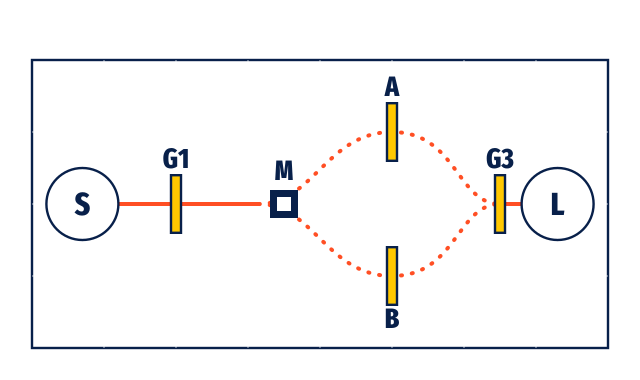
5.2. The course contains start S, first gate G1, recognition zone M, two alternative branches G2A and G2B, common gate G3 and landing pad L. Only one G2 branch is traversed. Each passage is directed from start to finish.
| Element | Base centre on the plan, in metres | Height of the opening centre |
|---|---|---|
| S | x=0,7; y=2,0 | Start on the floor |
| G1 | x=2,0; y=2,0 | 1,0 m |
| M | x=3,5; y=2,0 | A vertical marker at a height of 1,0 m and its duplicate on the floor in front of the panel |
| G2A | x=5,0; y=3,0 | 1,0 m |
| G2B | x=5,0; y=1,0 | 1,0 m |
| G3 | x=6,5; y=2,0 | 1,5 m |
| L | x=7,3; y=2,0 | Landing on the floor |
5.3. Coordinates are measured from the lower-left corner of the diagram, with the x-axis directed from start to finish. Gate openings are 800×800 mm, soft or protected by soft material; frame thickness is no greater than 100 mm. Zones S and L are circles 1 m in diameter. Supports are positioned outside the usable opening.
5.4. Large labels G1, A, B and G3 are placed on the gates. The operator publishes the basic dimensions, contrasting appearance of the frames, photographs, marker files and a recognition test example by 1 November. These materials are available to all registered teams.
5.5. Before each round, the centres of G1 and G3 may be shifted along y by no more than 0,25 m and their heights changed by no more than 0,15 m, identically for all teams. The remaining geometry is retained. The judge announces the layout before a shared 15-minute program-adjustment window; changes are not applied during a round.
5.6. Gate dimensions, marker format, ID-to-branch mapping and course-change limits do not change after registration. Fixed supports and panel M are protected; teams are shown the routes around the panel. The drone is not required to cross the physical panel M.
Basic course layout. Dashed lines show both permitted branches; one is traversed per attempt.
6 Computer vision and autonomy
6.1. M uses ArUco, dictionary DICT_4X4_50, ID 0 or ID 1. The outer side length of the black square is 200 mm; the white border is at least 20 mm on each side; printing is matte, without scaling or distortion of proportions. The vertical marker and its floor duplicate have the same ID within an attempt.
6.2. ID 0 means branch A — left when facing from the start; ID 1 means branch B — right. Both alternatives have equal status, and the openings are positioned symmetrically. Each drone reads the ID using its own camera during the attempt. Processing a previously saved image instead of the current video is prohibited.
6.3. The judge sets the ID after the program is locked and before the start. Both IDs are used across each team's three attempts: one appears twice and the other once; the sequence is determined by a concealed draw. An additional attempt in the event of a complete tie uses the same ID for the tied teams. The team must not enter the displayed ID value into the program before the start.
6.4. The program is locked before each round using a SHA-256 checksum. After locking and until the attempt is performed, editing and command input are prohibited except for the single launch and emergency termination. Between rounds, students may refine their code during the allotted time; the mentor must not program for the team.
6.5. One program launch is permitted on the judge's signal. Thereafter, flight commands come only from the algorithm. Screen recording and an event log with timestamps, the recognised ID and selected branch are enabled on the laptop. Judges may check the code, model files and the log's consistency with the video recording.
6.6. Before scored runs, the judge conducts a short test: after the program is locked, the judge changes the displayed marker, and the students demonstrate a change in the recognised ID without manual selection. The branch shown in the test does not remove the requirement for recognition in every scored attempt.
Attempts and points
7.1. The technical committee checks mass and dimensions in flight configuration, protection, battery, radio channel, video stream, software limits and two commands — normal autonomous completion and emergency landing or stop. Loss of communication is tested safely. An aircraft without a functioning emergency response is not admitted.
7.2. After substantial repairs, replacement of the camera, firmware or propulsion system, or a switch to another model, the affected parameters are checked again. Replacing a battery with an identical serviceable one is permitted without a full committee inspection.
7.3. Each team is given five minutes on the main course before the scored rounds. The team selects its emergency-command operator in advance; this must be a registered student. The safety judge has an independent right to stop an unsafe flight.
7.4. All admitted teams make one attempt in each of three rounds. The order in the first round is determined by a draw, the second is the reverse order, and the third is determined by a new open draw. No team performs all three runs consecutively. There is no elimination from the final after the first round.
7.5. The called team is given one minute for setup and connection. Once ready and upon the signal, an attempt lasting up to 180 seconds begins. Up to two minutes are allotted for changing teams and resetting the field. Batteries are prepared in advance; relaunching from the floor after the start is prohibited.
8 Attempt execution and scoring
8.1. The sequence is mandatory: autonomous take-off → G1 → reading M → correct G2A or G2B → G3 → landing L. Each element scores only once. If an element is missed, the drone may return and complete it correctly before time expires; subsequent elements do not count until then.
| Element | Scoring condition | Points |
|---|---|---|
| Take-off | After the start, the drone independently rises and remains airborne for at least 2 seconds | 5 |
| G1 | The entire drone passes through the opening in the required direction | 15 |
| M | The current ID is correctly read by the camera and recorded in the log before the branch is selected | 15 |
| G2 | The correct branch for the current ID; the entire drone passes through the opening | 25 |
| G3 | Complete passage after the correct branch | 20 |
| L | After all elements, the drone lands with its entire projected footprint inside circle L and stops its motors | 20 |
| Maximum | Before deduction of penalties | 100 |
8.2. Flying outside the frame, bypassing a gate and partial entry do not count as passage. Reading the ID again gives no additional points. Passing through the wrong branch earns no G2 points; the drone may return and complete the correct branch, and time does not stop.
8.3. A successful landing requires the drone's entire projected footprint, including protection, to be inside the circle and its motors to remain stopped for at least three seconds. Touching the line means crossing the inner boundary and earns no L points. Landing outside the zone ends the attempt without L points.
8.4. Time is measured from the authorised program launch until first contact in a subsequently confirmed successful landing. For an unfinished course, the record states “not completed” rather than a notional record time. At 180 seconds, the judge terminates the flight with the emergency command; points already earned legitimately are retained.
8.5. One continuous contact with a gate frame or panel M incurs minus 5 points; separation followed by another touch constitutes a new contact. If the contact creates no hazard and the drone continues controlled flight, the attempt continues. The minimum final attempt score is zero.
8.6. Contact with the net incurs minus 10 and ends the attempt. A fall, unintended floor contact or use of the emergency command ends the attempt, retaining previously earned legitimate points and assessed penalties, without finish points. A person must not enter while propellers are running.
8.7. Manual course correction, concealed commands and code substitution result in a zero score for the attempt; repeated or deliberately concealed intervention is considered grounds for disqualification. Emergency termination for safety is not considered manual course completion and is not, in itself, a disciplinary violation.
8.8. If the enclosure is breached, the drone flies towards people or safe control is lost, the judge stops the attempt immediately. The cause must be remedied and admission renewed before the next start. The sanction for a dangerous action is determined according to its circumstances.
Final result
9.1. The result is the sum of the two highest-scoring attempts out of three, with a maximum of 200. Selection scores are not added. The two attempts are selected automatically by points; in a tie, preference goes to a completed attempt, then to the shorter confirmed finish time, then to the earlier attempt number.
9.2. Tied final totals are resolved by comparing, in order: the number of fully completed courses among the two selected attempts; the sum of those finish times, if their equal number is greater than zero; the best single score; and the third attempt's score. Times of unfinished flights are not used as an advantage.
9.3. If a tie remains and affects I–III places or the award cutoff, an additional attempt is held using an identical layout and the same ID. Points are compared, followed by whether there was a full finish and its time. If a complete tie occurs again, a shared place is awarded and the corresponding next place is skipped; no endless series is held.
9.4. Confirmed external interference, failure of the organiser's infrastructure, an officiating procedural error or displacement of a gate through no fault of the team results in a full repeat of the attempt. The annulled attempt is not selected for the final result. The repeat uses the same layout and ID after the field is restored.
9.5. Battery depletion, failure of the team's own program, loss of communication affecting only that team without a confirmed external cause, a collision caused by the team's own error and equipment unreadiness do not entitle the team to a repeat. In a general radio failure, the judge records the affected teams and applies the same decision to all.
9.6. A scoring judge, a safety judge and a secretary work on the course; a technical inspector handles admission. An official wide-angle flight recording showing the openings, start and landing is mandatory. If visibility is inadequate, a camera is added rather than assuming passage through an unseen element.
9.7. The attempt record contains the team, round number, marker ID, program hash, drone identifier, scoring for each element, contacts and penalties, whether and when a full finish occurred, the reason for stopping, a recording link and the judge's signature. The team reviews it before the appeal period begins.
9.8. A protest must be submitted within 15 minutes after the result is communicated, under section 6 of the Regulations. Round results are published before the next round begins; a dispute affecting starting conditions or admission is resolved before the relevant run.
10 Category provision
10.1. The organiser provides an enclosed course, soft gates, two sets of verified markers, markings, scales and measuring tools, video recording, a timer, power outside the flight zone and a holding area. The team provides approved aircraft, a laptop, the software environment, batteries and an emergency interface.
10.2. For 20 teams, one course provides 60 scored slots of approximately six minutes each and 100 minutes of total time for sequential individual practice. Technical admission and code checks are conducted at separate workstations. The two-day schedule includes breaks and reserve time for repeats; practice access must not be selectively reduced.
10.3. The operator publishes the technical package by 1 November and answers general questions through a single clarification section until 26 November. Clarifications do not change the published limits or scoring scale. All teams have access to the same current version of the package.